The published specification
Scroll the table sideways to see every column.
Quick picks
The answer first. Tap any row to jump to the full reasoning for that pick.
Prices shown are checked daily against the retailer, as of October 23, 2026. We never write a price into the text of a page.
| # | Product | Best for | Award | Price |
|---|---|---|---|---|
| 1 | 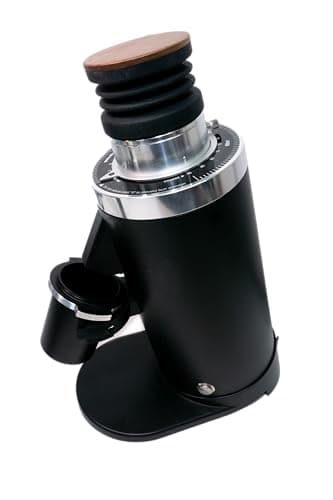 | Espresso enthusiasts who keep several coffees open | The grinder reviewed | |
| 2 | 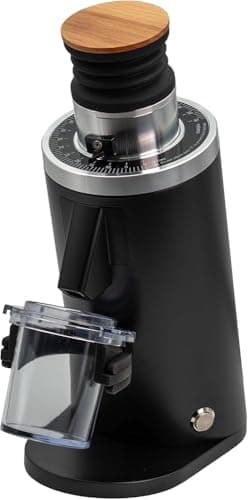 | Small kitchens | The compact alternative | |
| 3 | 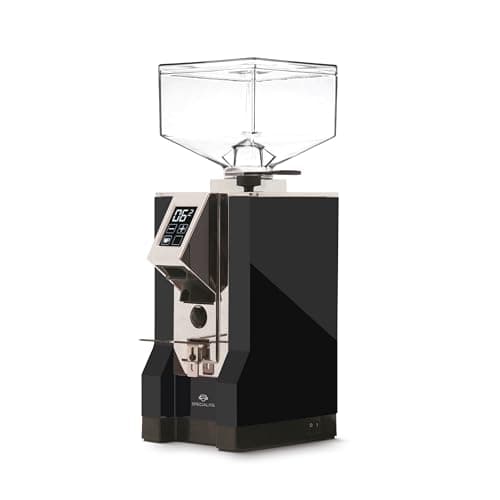 | One coffee, ground fast and quietly | The other direction |
1. The grinder reviewed
DF64 Gen 2
Upper-mid tier · The 64 mm flat-burr single-dose grinder that made the format mainstream at home.
Enthusiast-tier burrs and retention at a price that used to buy neither.
The DF64 Gen 2 is a single-dose grinder built around 64 mm stainless flat burrs with stepless adjustment, a 250 W motor running at 1400 rpm on 110/120 V, a 50 g hopper, and published retention under 0.1 g. It measures 13 cm wide by 22.5 cm deep by 30 cm tall and weighs 6.8 kg.
Sixty-four millimeters is the burr size the espresso world benchmarks against, and getting it in a home-priced grinder is the entire reason this machine matters. The particle distribution from a flat set that size is narrower than any conical grinder at a comparable price produces.
Sub-0.1 g retention is what makes the single-dose workflow honest. Weigh 18 g, get 18 g, with nothing from the last bean carried over. Ionizer probes built into the inner chute wall handle the static that would otherwise scatter it.
The burrs are swappable, which is the specification with the longest tail: aftermarket sets - including coated and differently-geometried options - let the grinder be re-tuned toward clarity or body rather than replaced.
Specification
- Burrs
- 64 mm flat stainless; aftermarket sets available
- Adjustment
- Stepless
- Retention
- Under 0.1 g
- Motor
- 250 W, 1400 rpm at 110/120 V
- Hopper
- 50 g
- Size
- 13 cm W x 22.5 cm D x 30 cm H, 6.8 kg
What it does well
- 64 mm flats are the burr size the espresso world benchmarks against
- Burrs are swappable, so the grinder can be re-tuned rather than replaced
- Ionizer probes in the chute keep static manageable
Where it gives ground
- Heavy and tall for a home counter
- Stepless adjustment with no detents demands note-keeping
- Version numbering across sellers is genuinely confusing
Skip it if
Skip it if you want to press a button. Single dosing is weigh, load, grind, bellows, every time.
2. The compact alternative
DF54
Upper-mid tier · A single-dose grinder with 54 mm flat burrs and stepless adjustment.
The same idea in a grinder that fits under a cabinet.
If 30 cm of vertical clearance is the problem, the DF54 delivers most of the same proposition in a smaller body: 54 mm flat burrs, stepless adjustment, sub-0.1 g retention, a 150 W motor at 1400 rpm and a 25 g hopper.
At 11 cm wide, 19 cm deep and 29.7 cm tall it is meaningfully more counter-friendly.
Fifty-four millimeter flats give up some throughput and some of the particle-distribution advantage of 64 mm, but they remain firmly in flat-burr territory rather than behaving like a conical set.
It includes a bellows with lid and a 58 mm dosing cup, and has the same ionizer approach to static.
Specification
- Burrs
- 54 mm flat
- Adjustment
- Stepless
- Retention
- Under 0.1 g
- Motor
- 150 W, 1400 rpm
- Hopper
- 25 g single-dose
- Anti-static
- Ionizer in the exit chute
What it does well
- Flat burrs and stepless adjustment at a price that used to buy neither
- Near-zero retention means the dose you weigh is the dose you get
- Small footprint for a flat-burr grinder
Where it gives ground
- Stepless with no reference marks is fiddly until you make your own
- Single-dose only - no hopper workflow for a busy household
- Bellows and a dosing cup are part of the routine, not optional extras
Skip it if
Skip it if you have the space for a DF64. Bigger burrs are the point of this category.
3. The other direction
Eureka Mignon Specialita
Upper-mid tier · An Italian 55 mm flat-burr espresso grinder with stepless micrometric adjustment.
If the single-dose ritual is the problem, this is the hopper answer with no loss of quality.
Not everyone wants a ritual, and the Specialita is the grinder to consider if you do not. Fifty-five millimeter flat hardened steel burrs made in Italy, with stepless micrometric adjustment on the lower burr.
The micrometric mechanism holds its setting through a strip-down clean, which is genuinely useful and something many stepless grinders do not manage.
Eureka publishes output up to 1.8 g per second, so an 18 g dose takes about ten seconds. Dosing is digital and timed to a tenth of a second.
It is also markedly quieter than the DF64, which matters in a shared home. The trade is the hopper: beans sit above the burrs, so switching coffees means emptying it.
Specification
- Burrs
- 55 mm flat hardened steel, made in Italy
- Adjustment
- Stepless micrometric on the lower burr
- Output
- Up to 1.8 g per second
- Dosing
- Digital timed, adjustable in tenths of a second
What it does well
- Genuinely quiet - the sound insulation is not marketing
- Micrometric adjustment holds its setting through a strip-down clean
- Fast enough that an 18 g dose is a ten-second job
Where it gives ground
- Hopper-fed by design; single dosing it is a workaround
- No weight-based dosing
- Espresso-focused - the coarse end is not its strength
Skip it if
Skip it if you keep several coffees open. Hopper-fed grinders make switching a chore.
What 64 mm flat burrs actually change
Flat burrs cut with a narrower distribution of particle sizes than conical burrs. In the cup that reads as clarity - individual flavors distinguishable rather than blended into a single impression - where conical burrs produce more body and perceived sweetness.
Sixty-four millimeters also means throughput: more cutting surface engaged per rotation, so a dose grinds faster and cooler. Heat in the grounds is a real variable and one you cannot see.
Neither of these makes flat burrs better in the abstract. If you drink milk-based espresso and like a heavy, syrupy shot, a conical grinder may genuinely suit you more. The mechanism is explained properly here.
The retention figure, and why it is the headline
Under 0.1 g is the number that separates a real single-dose grinder from one that is merely marketed as one. Above a few tenths of a gram, a measurable portion of yesterday's coffee is in today's cup, and the dose you carefully weighed is not the dose that reached the basket.
For anyone dialing in - where the whole point is changing one variable at a time - that carryover quietly undermines the experiment.
Living with stepless adjustment
Stepless is the right choice for espresso and the more annoying choice to live with. There is no number to write down, so you mark your own reference points on the collar and keep notes per coffee. Owners develop systems for this within a week and then stop noticing.
In exchange you can land exactly where the shot wants to be, which stepped grinders cannot promise. It is a fair trade and it is the reason serious espresso grinders are stepless.
The workflow, honestly described
- 1Weigh the dose into the hopper - a scale is not optional here.
- 2Grind. The 250 W motor at 1400 rpm gets through a dose quickly.
- 3Use the bellows to puff the last grounds out of the chute.
- 4Tap or knock the dosing cup, then distribute and tamp.
That is about twenty extra seconds and two extra objects compared with a hopper grinder. It is a ritual. Whether it is a pleasant one is a question about you rather than about the grinder.
The practical objections
- Size. At 30 cm tall and 6.8 kg this is a serious counter presence. Measure your cabinet clearance.
- Version confusion. The Gen 2 line has been sold under several minor version numbers by different retailers, and the differences are genuinely hard to track.
- Noise. Quieter than a Sette, louder than a Eureka.
- Stepless notes. You will keep them, or you will lose your setting.
Verdict
This is the grinder to buy if you want the enthusiast burr standard without leaving the home-appliance price range, and if the single-dose ritual appeals rather than annoys. It is a poor choice for a household that wants to press a button, and an unnecessary one for anyone whose machine is the limiting factor. If your espresso machine has a pressurized basket, fix that before buying this.