The published specification
Scroll the table sideways to see every column.
Quick picks
The answer first. Tap any row to jump to the full reasoning for that pick.
Prices shown are checked daily against the retailer, as of October 23, 2026. We never write a price into the text of a page.
| # | Product | Best for | Award | Price |
|---|---|---|---|---|
| 1 | 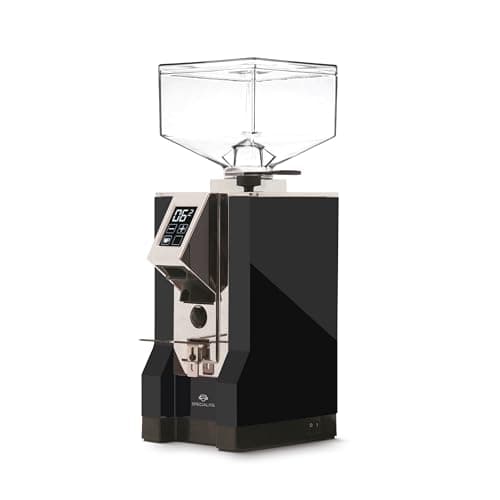 | A dedicated espresso setup, one coffee at a time | The grinder reviewed | |
| 2 | 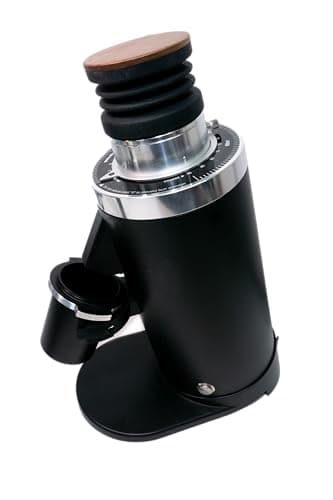 | Anyone who switches coffees often | The single-dose alternative | |
| 3 | 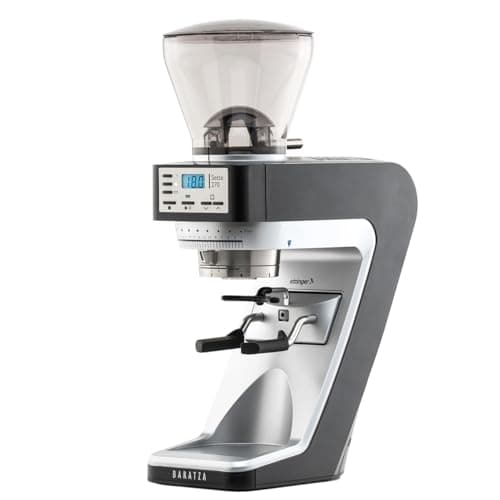 | Espresso-only setups where speed matters most | The faster alternative |
1. The grinder reviewed
Eureka Mignon Specialita
Upper-mid tier · An Italian 55 mm flat-burr espresso grinder with stepless micrometric adjustment.
The espresso grinder to buy if you want to stop thinking about grinders.
The Specialita uses 55 mm flat hardened steel burrs made in Italy, with stepless micrometric adjustment acting on the lower burr. Eureka publishes output up to 1.8 g per second, which puts an 18 g double at roughly ten seconds. Dosing is digital and timed, adjustable in tenths of a second, with single and double presets.
The micrometric mechanism is what separates this from other stepless grinders in practice: it can be disassembled for cleaning and reassembled without losing the setting. On a grinder you clean regularly, that is the difference between a five-minute job and re-dialing every coffee you own.
The sound insulation is genuine. Eureka builds it in deliberately, and among electric espresso grinders this is one of the quieter options - which matters more than the spec sheet suggests in a household where someone is still asleep.
It is hopper-fed by design. Single dosing it is a workaround rather than a supported workflow, and retention is not in the sub-0.1 g class that purpose-built single-dose grinders publish.
Specification
- Burrs
- 55 mm flat hardened steel, made in Italy
- Adjustment
- Stepless micrometric on the lower burr
- Output
- Up to 1.8 g per second
- Dosing
- Digital timed, adjustable in tenths of a second
What it does well
- Genuinely quiet - the sound insulation is not marketing
- Micrometric adjustment holds its setting through a strip-down clean
- Fast enough that an 18 g dose is a ten-second job
Where it gives ground
- Hopper-fed by design; single dosing it is a workaround
- No weight-based dosing
- Espresso-focused - the coarse end is not its strength
Skip it if
Skip it if you keep several bags open and want to switch freely. That is what a single-dose grinder is for.
2. The single-dose alternative
DF64 Gen 2
Upper-mid tier · The 64 mm flat-burr single-dose grinder that made the format mainstream at home.
Bigger burrs and sub-0.1 g retention, at the cost of a daily ritual.
If the hopper is the objection, the DF64 is the grinder to compare against: 64 mm stainless flat burrs, stepless adjustment, retention under 0.1 g, a 250 W motor at 1400 rpm and a 50 g hopper.
Sixty-four millimeters against fifty-five is a real difference in cutting area, and the burrs are swappable, so the grinder can be re-tuned over time.
Sub-0.1 g retention means switching coffees costs nothing, which the Specialita's hopper cannot match.
The costs are size - 30 cm tall and 6.8 kg - noise, and about twenty extra seconds per brew for the bellows and dosing cup.
Specification
- Burrs
- 64 mm flat stainless; aftermarket sets available
- Adjustment
- Stepless
- Retention
- Under 0.1 g
- Motor
- 250 W, 1400 rpm at 110/120 V
- Hopper
- 50 g
- Size
- 13 cm W x 22.5 cm D x 30 cm H, 6.8 kg
What it does well
- 64 mm flats are the burr size the espresso world benchmarks against
- Burrs are swappable, so the grinder can be re-tuned rather than replaced
- Ionizer probes in the chute keep static manageable
Where it gives ground
- Heavy and tall for a home counter
- Stepless adjustment with no detents demands note-keeping
- Version numbering across sellers is genuinely confusing
Skip it if
Skip it if the ritual is the thing you are trying to avoid. The Specialita exists precisely for that.
3. The faster alternative
Baratza Sette 270
Upper-mid tier · A straight-through espresso grinder with 270 adjustment steps and very low retention.
Higher throughput and near-zero retention by design, and much louder.
The Sette 270 attacks the same problem from a different angle: a straight-through grind path means almost nothing is retained, with no bellows required.
Baratza publishes 3.5 to 5.5 grams per second from 40 mm conical burrs made in Liechtenstein, driven by a 290 W motor - faster than the Specialita's published 1.8 g per second.
Adjustment is 270 steps, 30 macro by 9 micro, which is a hybrid giving repeatable coarse positions with genuine fine adjustment inside each.
The noise is the reason many people choose the Eureka instead. Owners consistently describe the Sette as loud, and it is a conical rather than flat burr set, so the cup leans toward body rather than clarity.
Specification
- Burrs
- 40 mm conical, made in Liechtenstein
- Settings
- 270 steps (30 macro x 9 micro)
- Output
- 3.5-5.5 g per second
- Power
- 290 W
- Hopper
- 10 oz
What it does well
- Straight-through path means almost nothing is left behind between doses
- 270 steps is enough resolution to chase a shot properly
- Very fast for a home grinder
Where it gives ground
- Loud - genuinely loud, not grinder-loud
- The macro and micro system takes a while to think in
- Filter range is a compromise; this is an espresso tool
Skip it if
Skip it if noise matters, or if you want flat-burr clarity. Those are the two things the Eureka does better.
Why micrometric adjustment is the feature to notice
Stepless grinders have one recurring practical problem: cleaning. Take the burrs out to remove old coffee and, on most designs, your setting is gone with them - so a routine clean means re-dialing every coffee in the cupboard.
The Specialita's micrometric adjustment acts on the lower burr through a mechanism that can be disassembled and put back without losing position. That turns cleaning from something you postpone into something you do.
Grinders accumulate stale oils and fines whether or not you clean them, and those end up in the cup. A design that removes the disincentive is doing something real.
Speed, and why it matters more than it should
Eighteen grams in around ten seconds is fast for a home grinder. The reason that matters is not impatience: a shorter grind time means less heat transferred into the grounds, and it means the grinder is not the slow step in the routine.
Timed dosing has a known weakness, though. As beans age and lose carbon dioxide their density changes, so a fixed grind time delivers a slightly different weight over the life of a bag. Anyone weighing their dose will notice this within a week and simply adjust; anyone relying on the timer alone will drift.
The hopper question
This is the one specification that decides whether the Specialita is right for you, and it is not really a specification at all - it is a workflow assumption.
A hopper grinder assumes you drink one coffee and grind it repeatedly. That is efficient, fast, and requires nothing extra. It also means beans sit above the burrs staling, and switching coffees means emptying the hopper and purging the burrs.
If you buy 1 kg bags and work through them, this is the right grinder. If you buy 12 oz bags of specialty coffee and keep three open, buy a single-dose grinder instead.
What 55 mm flats do to the cup
Flat burrs produce a narrower particle-size distribution than conicals, which reads as clarity and separation. Fifty-five millimeters sits below the 64 mm benchmark and well above the 40 mm conical entry tier, and behaves much more like the former.
For espresso specifically, that clarity is most obvious in straight shots of lighter roasts. In a milk drink the difference narrows considerably, which is worth knowing if lattes are what you make.
Verdict
Buy it if you have a dedicated espresso setup, drink one coffee at a time, value quiet, and want a grinder that will not need to be replaced. Do not buy it if you switch coffees constantly - the hopper fights you - or if you want the last increment of burr size, which is the DF64's argument. Either way, it is more grinder than most home espresso machines can fully exploit, which is the right direction to over-buy in. And if you are still deciding between this and its siblings, which Eureka Mignon to buy sets the whole line side by side - the Silenzio now shares these burrs for less.