The short answer
Buy the Mignon Silenzio 55 for espresso. It uses the same 55 mm flat hardened steel burrs and the same stepless micrometric adjustment as the Specialita above it, with sound insulation, for noticeably less money - compare the buttons on this page, because the Specialita's extra cost buys a touch display and two programmable doses, not a better grind. Buy the Zero instead if you single dose, because it is the only model built for it (45 g hopper, bellows, anti-retention). Buy the Filtro Silent if you brew filter rather than espresso, because the filter range uses brew-specific burrs and no espresso model does. Skip the Libra: it is roughly double the Silenzio for the same burrs, and the premium buys a built-in scale you almost certainly already own.
First decision: espresso range or filter range
Eureka splits the Mignon line into an espresso range and a filter range, and this is the distinction that trips people up most, because the models look nearly identical on a shelf.
The espresso models - Notte, Silenzio, Specialita, Zero, Libra - use burrs cut for espresso. The filter models - Filtro Silent and the Crono - use 50 mm burrs with brew-specific geometry and a redesigned grind path.
Burr geometry is not a marketing distinction. Burrs cut for espresso are optimized for a very fine, narrow particle distribution under pressure; brew burrs are cut to produce an even grind at much coarser settings. Using an espresso grinder for pour-over works, but you are paying more for burrs pointed the wrong way - and the same is true in reverse. Conical versus flat burrs covers why geometry changes the cup.
What every Mignon shares
Before the differences, the common platform - because it is most of what you are paying for, and it is why the cheap models are still worth considering.
- Stepless micrometric regulation. Eureka's patented adjustment system, on every model here. Infinite settings rather than clicks, which is what lets you land on a setting instead of straddling it.
- The same compact Italian chassis. Small footprint, metal body, and a line of spare parts that has been supported for years.
- 1350 rpm burr speed across the models that publish it, which is deliberately moderate to limit heat and static.
- The ACE system (Anti-Clumps and Electrostaticity) on the current models, which is Eureka's name for the anti-clumping and anti-static treatment of the grind path.
So the question is never whether a Mignon is a good grinder. It is which of four variables you are paying for: burr diameter, dosing method, sound insulation, and hopper size.
Scroll the table sideways to see every column.
Quick picks
The answer first. Tap any row to jump to the full reasoning for that pick.
| # | Product | Best for | Award | Price |
|---|---|---|---|---|
| 1 | 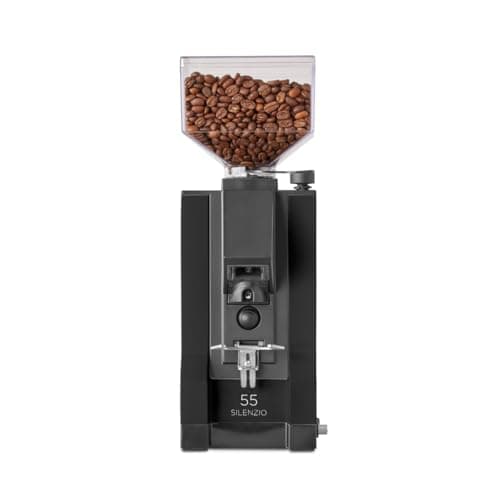 | Espresso at home, where you want the good burrs and not the touchscreen | Top pick | |
| 2 | 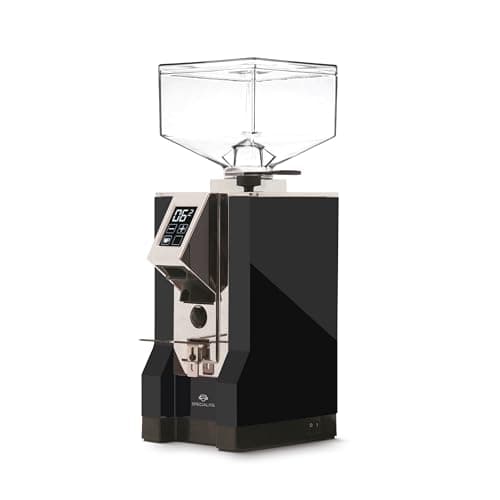 | A repeatable daily workflow, especially if more than one person uses it | Best interface | |
| 3 | 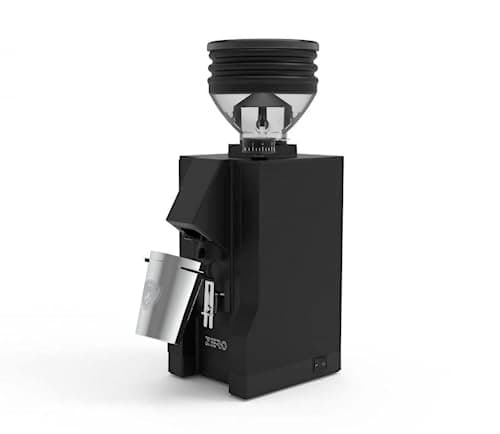 | One bag at a time, light roasts, and switching coffees often | Best for single dosing | |
| 4 | 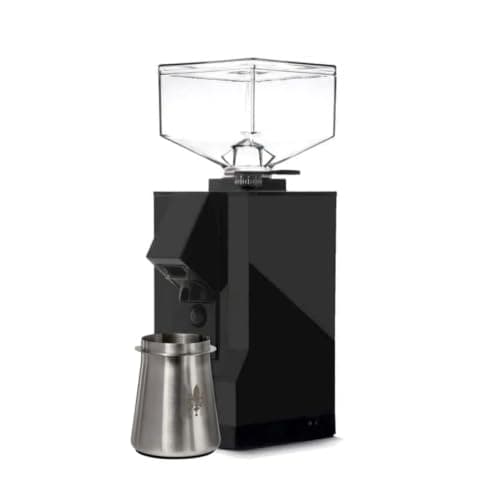 | V60, Chemex, Kalita and batch brew - not espresso | Best for filter and pour-over | |
| 5 | 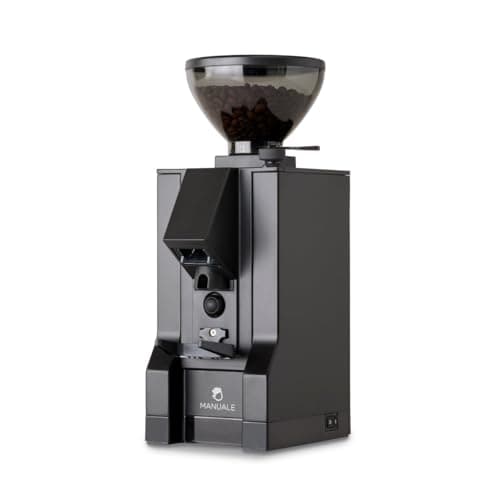 | Getting the micrometric adjustment mechanism on the smallest budget | Cheapest way in | |
| 6 | 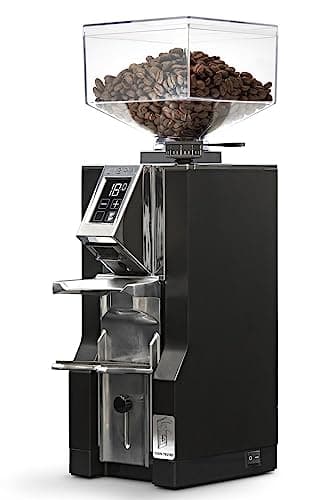 | Hands-free repeat dosing by weight, if that specific convenience is worth the premium | Skip this one |
1. Top pick
Eureka Mignon Silenzio 55
Upper-mid tier · The silenced Mignon on 55 mm burrs, switchable between manual and timed dosing.
The 55 mm burr platform with sound insulation, for noticeably less than the Specialita.
The Silenzio is the model most people should buy, and the reason is that Eureka moved it onto the 55 mm burr set. It used to run 50 mm burrs; the current version - sold as the Silenzio 55 - uses the same 55 mm flat hardened steel burrs as the Specialita above it.
That matters because burr diameter is the specification that separates the espresso range. Once the Silenzio got 55 mm burrs, the gap to the Specialita stopped being about grinding and started being about the interface.
It keeps Eureka's stepless micrometric regulation, which is the feature worth having across this whole line: adjustment is infinite rather than stepped, so you can land on a setting instead of jumping past it. Retailers publish a 310 W motor and output of roughly 1.2 to 1.8 g per second at espresso.
Dosing is switchable between manual and a timer, which is more flexible than it sounds - you can run it as a simple on-demand grinder or set a time and walk away. The 55 version also carries the hands-free adjustable portafilter fork.
What you give up is the touch display and the two programmable doses. You also give up nothing in the cup. One caution worth repeating: the older 50 mm Silenzio is still in circulation, so check the burr size on the listing before you buy.
Specification
- Burrs
- 55 mm flat hardened steel, made in Italy
- Adjustment
- Stepless micrometric regulation
- Dosing
- Switchable manual or timer
- Motor
- 310 W
- Output
- Retailers publish 1.2 to 1.8 g per second at espresso
- Noise
- Silent Technology - retailers publish about 65 dB
What it does well
- The same 55 mm burr platform as the Specialita for noticeably less
- Switchable manual or timer dosing instead of one fixed workflow
- Hands-free adjustable portafilter fork is standard on the 55
Where it gives ground
- No touch display and no programmable doses
- Hopper-fed by design, so single dosing is a workaround
- The earlier 50 mm Silenzio is still in circulation - check the burr size before buying
Skip it if
Skip it if you want programmable doses on a display, or if you are going to single dose - the Zero is built for that and this is not.
2. Best interface
Eureka Mignon Specialita
Upper-mid tier · An Italian 55 mm flat-burr espresso grinder with stepless micrometric adjustment.
The same 55 mm burrs with a touch display and two programmable doses.
The Specialita is the model this site already reviewed in full, and it remains the one to buy if the interface matters to you. Eureka describes it as the version conceived for the barista: 55 mm burrs, an all-purpose hands-free fork, and a touch display with two programmable doses plus a continuous mode.
Those two programmable doses are the real difference from the Silenzio. A single and a double, each stored and repeatable, is a genuinely better interface when the grinder is used by more than one person or more than one way.
Its adjustment is the same stepless micrometric system, and it holds its setting through a strip-down clean - which is the quiet reason this line has the reputation it does.
It is fast. An 18 g dose is about a ten-second job at up to 1.8 g per second, and the sound insulation is not marketing: this is a grinder you can run early without annoying the house.
It costs meaningfully more than the Silenzio for the same burrs, it is hopper-fed by design so single dosing is a workaround, and it has no weight-based dosing. The full review is here.
Specification
- Burrs
- 55 mm flat hardened steel, made in Italy
- Adjustment
- Stepless micrometric on the lower burr
- Output
- Up to 1.8 g per second
- Dosing
- Digital timed, adjustable in tenths of a second
What it does well
- Genuinely quiet - the sound insulation is not marketing
- Micrometric adjustment holds its setting through a strip-down clean
- Fast enough that an 18 g dose is a ten-second job
Where it gives ground
- Hopper-fed by design; single dosing it is a workaround
- No weight-based dosing
- Espresso-focused - the coarse end is not its strength
Skip it if
Skip it if you only ever pull one dose size. You are paying for a second programmable dose and a display you will not use.
3. Best for single dosing
Eureka Mignon Zero
Upper-mid tier · The 55 mm Mignon rebuilt around single dosing, with a 45 g hopper and a bellows.
The 55 mm Mignon rebuilt around a 45 g hopper and a bellows.
The Zero is the only model in the line that is designed for single dosing rather than adapted to it. Eureka publishes a 45 g bean hopper and a 45 g basket, which tells you the whole story: you weigh beans in, you grind, the chamber empties.
It uses the same 55 mm flat hardened steel burrs at 1350 rpm, on a slightly stronger 320 W motor, and Eureka publishes the highest output figures in the range - 1.8 to 2.5 g/s at espresso and 2.5 to 3.5 g/s at brew.
Eureka names a Blow Up system, an Anti-Retention system and the ACE anti-clumping system on this model. The Blow Up bellows is the practical one: a puff of air clears coffee out of the grinding chamber between doses.
This is the model to buy if you buy small bags of single origin and switch between them, because a hopper grinder holds the last coffee in its path and the first dose of a new bag is a blend you did not ask for.
Two honest limits. Eureka publishes no retention figure anywhere on its own specification page, so the anti-retention claim cannot be checked against a number - and this site does not substitute one from a review. And it costs more than the Silenzio for the same burr set, so you are paying for the workflow, not the grind.
Specification
- Burrs
- 55 mm flat hardened steel
- Burr speed
- 1350 rpm
- Power
- 320 W
- Bean hopper
- 45 g
- Output
- 1.8 to 2.5 g/s espresso; 2.5 to 3.5 g/s brew
- Dimensions
- 345 x 120 x 140 mm, 5.6 kg
- Named systems
- Blow Up, Anti-Retention, ACE, Silent Technology
What it does well
- Built for single dosing rather than adapted to it
- The fastest Mignon on paper - Eureka publishes up to 2.5 g/s at espresso
- Blow Up bellows clears the chamber between doses
Where it gives ground
- Eureka publishes no retention figure, so the claim cannot be checked
- The 45 g hopper means weighing beans for every dose
- Costs more than the Notte and the Filtro for the same 55 mm burr set as the Silenzio
Skip it if
Skip it if you buy coffee by the kilo and brew the same bean every day. You would be weighing beans for every dose to solve a problem you do not have.
4. Best for filter and pour-over
Eureka Mignon Filtro Silent
Mid tier · The filter-range Mignon: brew-specific 50 mm burrs and a hand-brew dosing cup.
Brew-specific burrs, which is the one thing no espresso Mignon can do.
This is the model people miss, and it is the most important distinction on the page: the Mignon line has an espresso range and a filter range, and they use different burrs.
The Filtro Silent runs 50 mm flat burrs with brew-specific geometry and a redesigned grind path. Burrs cut for filter produce a different particle distribution from burrs cut for espresso, and at coarse settings that difference is audible in the cup.
It ships with a Hand Brew dosing cup rather than a portafilter fork, has a 12 oz hopper, the same stepless micrometric adjustment, and manual dosing from a side-mounted switch. Motor and case insulation make it the cheapest silenced grinder in the line.
If pour-over is what you brew, this is the correct Mignon and a 55 mm espresso model is the wrong one - no matter that it costs more. Buying the expensive espresso grinder for filter coffee is the most common mistake in this lineup.
The reverse is equally true and worth stating plainly: brew burrs are the wrong tool for espresso. This is not an all-rounder, it has no timer, and it is 50 mm rather than the 55 mm the espresso range moved to. See grinders for pour-over for how it sits against other brands.
Specification
- Burrs
- 50 mm flat, brew-specific geometry
- Adjustment
- Stepless micrometric regulation
- Dosing
- Manual, side-mounted switch
- Hopper
- 12 oz
- Included
- Hand Brew dosing cup
- Noise
- Motor and case insulation - Silent Technology
What it does well
- Burrs cut for filter rather than espresso, which is the whole point of it
- Cheapest silenced grinder in the Mignon line
- Ships with a dosing cup sized for hand brewing rather than a portafilter
Where it gives ground
- Brew burrs are the wrong tool for espresso - this is not an all-rounder
- Manual dosing only, with no timer
- 50 mm rather than the 55 mm the espresso range moved to
Skip it if
Skip it if you pull shots at all. The espresso range exists for a reason and this is not in it.
5. Cheapest way in
Eureka Mignon Notte
Mid tier · The entry Mignon: 50 mm burrs, manual dosing, and no sound insulation.
Eureka's stepless adjustment at the lowest price - with 50 mm burrs and no silencing.
The Notte is the entry point, and what it preserves is the thing worth preserving: the same Italian chassis and the same stepless micrometric regulation system as every model above it.
That is a real argument. The adjustment mechanism is what makes a Mignon a Mignon - infinite settings rather than steps - and the Notte has it at the bottom of the range.
It runs 50 mm flat steel burrs at 1350 rpm on a 260 W motor, with manual on-demand dosing. No timer, no display, no hands-free fork.
Its real compromise is noise. It is the one model here with no sound insulation, and the published figures show it: retailers list about 73 dB for the Notte against about 64 to 65 dB for the silenced models. That is not a small difference in a kitchen at six in the morning.
At this price the honest question is whether you want a Mignon specifically. A Baratza Encore ESP sits nearby and is a different set of trade-offs - and if you are weighing the whole category rather than this brand, the espresso grinder roundup is the page to read.
Specification
- Burrs
- 50 mm flat steel
- Burr speed
- 1350 rpm
- Power
- 260 W
- Adjustment
- Stepless micrometric regulation
- Dosing
- Manual, on demand
- Noise
- Retailers publish about 73 dB - no Silent Technology
What it does well
- The cheapest route to Eureka's stepless micrometric adjustment
- Same Italian chassis and the same adjustment mechanism as the dearer models
- Manual dosing is one less thing to program or mis-set
Where it gives ground
- 50 mm burrs rather than the 55 mm the rest of the espresso range uses
- The only model here without sound insulation, and the dB figures show it
- No timer, no display, no hands-free fork
Skip it if
Skip it if the grinder lives in an open-plan kitchen or near a bedroom. Spend the difference on the Silenzio and get 55 mm burrs as well as quiet.
6. Skip this one
Eureka Mignon Libra
Prosumer tier · The 55 mm Mignon with a scale built in, dosing by weight instead of by time.
A good grinder, and roughly double the Silenzio for a scale you probably own.
The Libra is the most capable grinder on this page and the one this site would not buy. It is the 55 mm Mignon with a scale built into the base - Eureka calls it Instant Grind Weighing Technology and describes it as patent-pending.
What it does is genuine. Doses are programmed by weight in 0.1 g steps, retailers publish variation of about 0.2 g per grind cycle, and because it stops at a weight rather than a time, the dose does not drift when you change the grind setting or open a different bag. It is also the quietest figure published in the range at about 64 dB, and the top burr lifts out for cleaning without losing the grind setting.
The problem is the arithmetic. Check the buy buttons on this page: the Libra is roughly twice the Silenzio, for the same 55 mm burrs, the same stepless adjustment and the same chassis. The entire premium buys the scale.
And you almost certainly own a scale. Espresso is a ratio of dose in to liquid out, so you need a scale under the cup regardless - which means the built-in one duplicates hardware already on your counter. This site made the same argument about the Baratza Sette 270 against the 270Wi, and it holds here more strongly because the premium is larger.
It is also still hopper-fed, so it does not solve what the Zero solves. If you want the dose handled for you AND single dosing, no Mignon does both.
Specification
- Burrs
- 55 mm flat hardened steel
- Burr speed
- 1350 rpm
- Dosing
- Grind by weight, programmable in 0.1 g steps
- Stated variation
- Retailers publish about 0.2 g per grind cycle
- Output
- Retailers publish 1.4 to 1.8 g per second at espresso
- Noise
- Retailers publish about 64 dB
- Named systems
- Instant Grind Weighing Technology, ACE, Silent Technology
What it does well
- Doses by weight rather than by time, so output does not drift with the grind setting
- The top burr lifts out for cleaning without losing the grind setting
- Quietest figure published anywhere in the range
Where it gives ground
- Roughly double the Silenzio for the same 55 mm burrs
- A standalone scale you already own measures the same dose for nothing
- Still hopper-fed, so it does not solve what the Zero solves
Skip it if
Skip it unless hands-free dosing by weight is specifically what you are buying and you have priced it against a Silenzio plus a scale.
The four variables, in order of how much they matter
1. Burr diameter: 50 mm or 55 mm
This is the one that changes the coffee. A larger burr set cuts more coffee per rotation, which means a faster grind at a given setting and - more usefully - a narrower particle distribution. The espresso range has moved to 55 mm on everything except the Notte.
The practical consequence: if you are choosing between the Notte and the Silenzio, you are choosing between 50 mm and 55 mm burrs, and that is a real difference. If you are choosing between the Silenzio, Specialita, Zero and Libra, the burrs are identical and the difference is interface and workflow only.
2. Dosing: manual, timer, display or weight
Manual means you hold a switch. A timer means you set seconds. The Specialita's display stores two doses. The Libra weighs the output and stops at a target weight.
Dosing by time has a known weakness: output flow rate changes with grind setting, bean density and roast, so a time calibrated on one bag is wrong on the next. Dosing by weight fixes that - which is the Libra's whole argument, and why it is worth understanding before dismissing the price.
3. Sound insulation
Eureka's Silent Technology is motor and case insulation with rubber mounts and gaskets. The published numbers put the silenced models around 64 to 65 dB and the Notte at about 73 dB.
Decibels are logarithmic, so that gap is larger in practice than the numbers suggest. In an apartment, or with a grinder near a bedroom, this is the specification that decides whether you can make coffee before anyone else is awake. For the wider picture, see the quiet grinder roundup.
4. Hopper size, which is really a workflow decision
A full hopper holds beans above the burrs and keeps coffee in the grind path between doses. That is convenient if you drink one coffee every day and a problem if you switch beans, because the path holds the last bean and the first dose of a new bag comes out as an unintended blend.
The Zero's 45 g hopper exists to remove that. Single dose versus hopper grinders is the full version of this trade-off.
Which Mignon, by situation
- Espresso, one or two people, normal kitchen. Silenzio 55. The 55 mm burrs and the quiet, without the display premium.
- Espresso, shared household or two dose sizes. Specialita. The programmable doses are the reason.
- You buy small bags and switch often. Zero. It is the only model built for single dosing.
- Pour-over, Chemex, batch brew. Filtro Silent. Brew burrs, not espresso burrs.
- The smallest budget, and noise does not matter. Notte. You keep the adjustment system; you lose 5 mm of burr and the insulation.
- You want weight-based dosing more than you want the money. Libra - having priced it against a Silenzio plus a standalone scale first.
The filter range and the Crono
The Crono is the Filtro's sibling: Eureka publishes 50 mm flat hardened steel brew burrs, a 150 g hopper, a 5 to 60 second timer, 1350 rpm, 310 W, the stepless micrometric system and the ACE system.
The difference from the Filtro Silent is dosing and hopper. The Crono gives you a timer and a larger 150 g hopper; the Filtro gives you manual dosing, a 12 oz hopper, a hand-brew dosing cup and the sound insulation.
It is not a pick here for a practical reason rather than a quality one: its stock comes and goes, and at the time of writing the listing was down to single figures. If you want a filter Mignon and the Crono is unavailable, the Filtro Silent is the same burr class with manual dosing instead of a timer.
What no Mignon does
Two honest ceilings, because the line gets recommended as though it were the end of the road.
First, these are 50 and 55 mm burr sets. Going to a 64 mm flat grinder is a further step in particle distribution, most audible on light roasts brewed as filter - a real but smaller improvement than the one from a blade grinder to a Mignon. DF64 against the Eureka Mignon is that comparison directly.
Second, no Mignon combines single dosing with weight-based dosing. The Zero gives you one, the Libra gives you the other, and if you want both you are shopping outside this line.
And the usual caveat applies in the other direction: a Mignon fed by stale supermarket coffee will not show you what it can do. Beans with a printed roast date change more than the step from 50 mm to 55 mm does.