The short answer
These grinders do not really compete. The Encore is a stepped conical filter grinder with a hopper and a published range of 250 to 1200 microns. The DF54 is a stepless flat-burr single-dose grinder with retention under 0.1 g that reaches espresso. If you make espresso, or want flat-burr clarity, the DF54 is the only one of the two that qualifies.
Specification side by side
Scroll the table sideways to see every column.
Quick picks
The answer first. Tap any row to jump to the full reasoning for that pick.
Prices shown are checked daily against the retailer, as of October 23, 2026. We never write a price into the text of a page.
| # | Product | Best for | Award | Price |
|---|---|---|---|---|
| 1 | 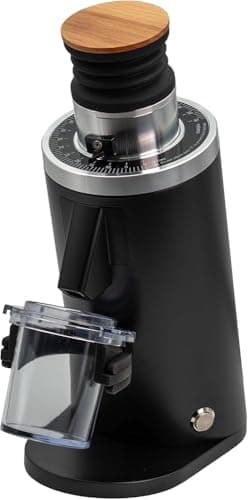 | Espresso, single dosing, or anyone chasing clarity in the cup | Choose this for espresso and clarity | |
| 2 | 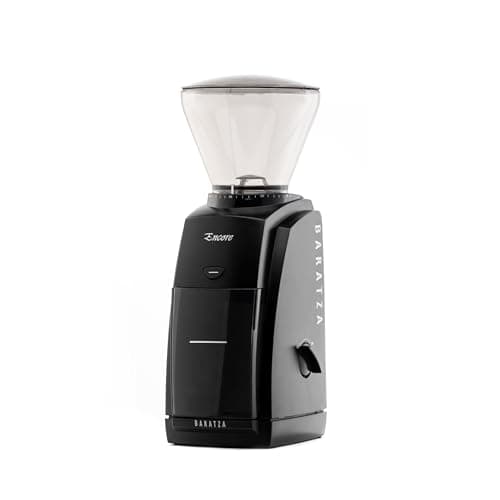 | Pour-over, drip and French press with no ritual | Choose this for simple filter brewing |
1. Choose this for espresso and clarity
DF54
Upper-mid tier · A single-dose grinder with 54 mm flat burrs and stepless adjustment.
Stepless 54 mm flats with retention under 0.1 g - a different class of tool.
The DF54 is a purpose-built single-dose grinder: 54 mm flat burrs, stepless adjustment, retention under 0.1 g, a 150 W motor at 1400 rpm and a 25 g hopper, with an ionizer in the exit chute to handle static.
Stepless adjustment is what lets it do espresso properly. There is no click to step over, so you land exactly where the shot wants to be rather than choosing between two settings.
Flat burrs give a narrower particle-size distribution than conicals, which shows up as clarity and separation in the cup - more distinguishable flavors, less blending.
At 11 cm wide, 19 cm deep and 29.7 cm tall it is compact for a flat-burr grinder, and a bellows with a lid is included for clearing residual grounds.
Specification
- Burrs
- 54 mm flat
- Adjustment
- Stepless
- Retention
- Under 0.1 g
- Motor
- 150 W, 1400 rpm
- Hopper
- 25 g single-dose
- Anti-static
- Ionizer in the exit chute
What it does well
- Flat burrs and stepless adjustment at a price that used to buy neither
- Near-zero retention means the dose you weigh is the dose you get
- Small footprint for a flat-burr grinder
Where it gives ground
- Stepless with no reference marks is fiddly until you make your own
- Single-dose only - no hopper workflow for a busy household
- Bellows and a dosing cup are part of the routine, not optional extras
Skip it if
Skip it if you want to load beans and press a button. Single dosing means weighing, loading and puffing every single time.
2. Choose this for simple filter brewing
Baratza Encore
Entry tier · The standard entry burr grinder for filter brewing.
Forty stepped settings, a published 250-1200 micron range, and years of parts support.
The Encore does one job and does it well: filter coffee, from a hopper, with 40 stepped settings across a published range of 250 to 1200 microns.
Its 40 mm conical burrs, made in Europe and turning at roughly 450 to 550 rpm, produce a wider particle distribution than flats - which reads as body and sweetness rather than clarity. For French press and drip, that is arguably the more pleasant direction.
Stepped settings are easier to live with than stepless: you write down 18, you return to 18, and it is the same grind. No reference marks, no notes.
It does not reach espresso - the published range stops at 250 microns - and retention is ordinary, so single dosing it is not the workflow it was designed for.
Specification
- Burrs
- 40 mm conical, made in Europe
- Settings
- 40 stepped
- Grind range
- 250-1200 microns
- Burr speed
- Roughly 450-550 rpm to limit heat and static
What it does well
- The reference answer for pour-over, drip and French press
- Fully serviceable, with parts sold individually for years
- Low burr speed keeps static and heat down
Where it gives ground
- Bottom of its range is too coarse for espresso - that is the ESP model job
- Stepped settings only
- Plastic body and a loud motor
Skip it if
Skip it if you make espresso, or if you want the clarity that flat burrs produce.
The three real differences
1. Espresso capability
This is the decisive one. The Encore's published range stops at 250 microns, which is filter-fine. Espresso needs finer, so this is not a question of adjustment or technique - the grinder does not go there. The DF54 does, with stepless adjustment that lets you land precisely.
2. Burr geometry, and what it does to the cup
Conical burrs cut with a wider spread of particle sizes; flat burrs produce a narrower one. The perceptual difference is body and sweetness against clarity and separation. Which you prefer is genuinely a matter of taste - a French press from a conical grinder is often more satisfying than the same coffee from flats, while a light-roast V60 usually goes the other way. The mechanism is explained here.
3. Workflow
The Encore is a hopper grinder: fill it, press the button, walk away. The DF54 is single dose: weigh the beans, load them, grind, use the bellows to clear the chute. That is about twenty extra seconds and three extra objects per brew. It buys you the ability to switch coffees freely and to know that the dose you weighed is the dose you brewed.
Stepped or stepless, practically
Stepped adjustment has an underrated advantage: it is recordable. Write down the number, come back a month later, and the grind is the same. Stepless grinders have no such number, so most owners end up marking their own reference points on the collar and keeping notes per coffee.
For filter brewing, where the useful range is wide, stepped is genuinely more convenient. For espresso, where the window is narrow, stepless is close to necessary.
The honest recommendation
- Filter only, want simplicity: Encore. It has been the right answer for years and still is.
- Any espresso at all: DF54, or the Encore ESP if the budget is tighter.
- Multiple coffees open at once: DF54, for the retention figure alone.
- Want body and sweetness rather than clarity: Encore, or another conical grinder.