The short answer
Buy the Chemex if you want the cleanest possible cup and brew two to four cups at once - its bonded filter is noticeably thicker than a V60 paper and removes more oils and fines than anything else here. Buy the Hario Switch if you brew one cup at a time and want one device that does immersion, pour-over or a hybrid of both. The Switch is the more forgiving of the two on an uneven grind, because its valve lets you steep instead of percolate.
They are solving different problems
This comparison gets framed as two pour-over brewers, and that is not quite what it is. The Chemex is a percolation brewer taken to one extreme: the thickest filter in common use, pursuing clarity. The Switch is a percolation brewer with an escape hatch into immersion.
So the real question is not which makes better coffee. It is whether you want one method done as thoroughly as possible, or two methods in one piece of glass.
Scroll the table sideways to see every column.
Quick picks
The answer first. Tap any row to jump to the full reasoning for that pick.
| # | Product | Best for | Award | Price |
|---|---|---|---|---|
| 1 | 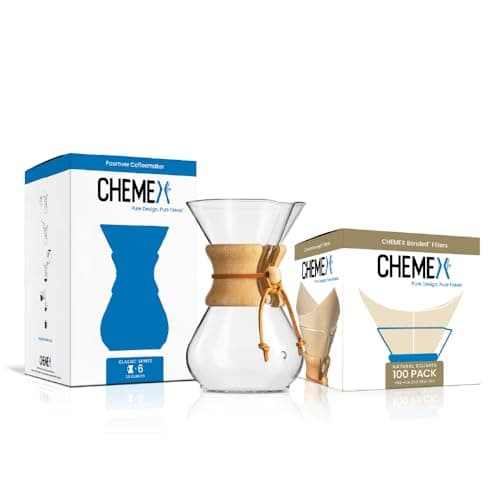 | Two to four cups at once, and anyone chasing a tea-like cup | Best for clarity and batch size | |
| 2 | 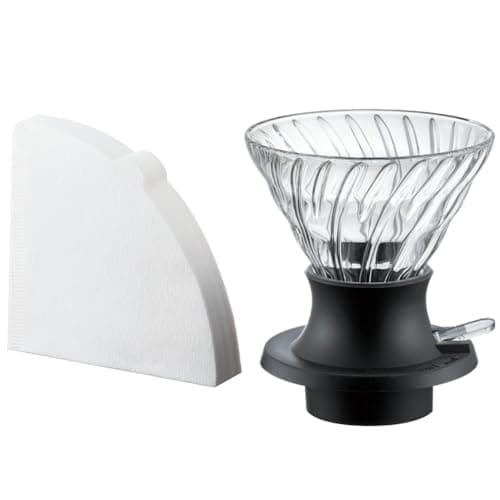 | One cup at a time, and anyone who wants to change method without buying again | Best for versatility | |
| 3 | 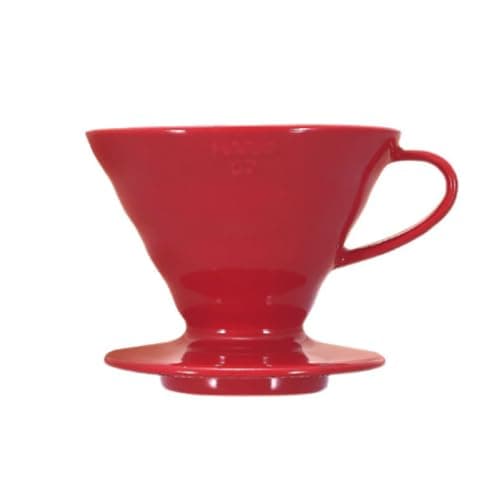 | Anyone sure they want pour-over and nothing else | The cheaper option if you only percolate |
1. Best for clarity and batch size
Chemex Classic 6-Cup
Manual tier · A single-piece borosilicate brewer that uses very thick bonded filters.
The thickest filter in common use, and the cleanest cup any manual brewer makes.
The Chemex is a cone over a glass carafe, and its distinguishing feature is the filter rather than the shape. Chemex bonded filters are substantially thicker than a V60 paper, which is the entire reason the cup tastes the way it does.
That thickness removes more oils and more fine particles than any other common paper, producing a cup people usually describe as clean, bright and tea-like. If clarity is the quality you want from filter coffee, nothing in this price range does it better.
It is also the better of the two for volume. The six-cup carafe brews a genuine pot, so it suits a household where two or more people want coffee at the same time - a job the Switch's single cone cannot do in one pass.
The thick filter has a cost: drawdown is slow, and a grind that is slightly too fine will stall the bed and leave you waiting. This is the brewer that most wants an even, medium-coarse grind.
The filters are proprietary and more expensive than V60 papers, and the glass body and wooden collar need more care than a ceramic cone. See the Chemex review for the full picture.
Specification
- Capacity
- 30 oz
- Size
- 8.5 in H x 5.125 in diameter
- Material
- Borosilicate glass, wood collar and leather tie
- Filters
- Chemex Bonded (FP-1, FC-100, FS-100, FSU-100)
What it does well
- The thick bonded filter produces the cleanest cup of any common brewer
- Brews and serves in one vessel, which matters when guests are involved
- It looks like an object, not an appliance
Where it gives ground
- The proprietary filters are a permanent running cost
- Slow, and unforgiving if you grind too fine
- Glass, with a wood collar that should not be soaked
Skip it if
Skip it if you brew one cup at a time, or if you want body in the cup - the filter is designed to remove exactly that.
2. Best for versatility
Hario Switch Immersion Dripper 02
Budget tier · A V60-style glass dripper with a ball valve, so it can steep like an immersion brewer and then drain.
A V60 cone with a valve, so one brewer does immersion, percolation or both.
The Switch is a V60 cone with a stainless steel ball valve in the base. Closed, water sits in the cone and the coffee steeps like a French press; open it and the brew drains through the familiar 60-degree cone as pour-over.
That makes it the only brewer here that changes category on demand. The hybrid recipes - steep for a while, then release - are the reason enthusiasts buy it, because immersion extracts evenly while the paper still removes the fines.
Practically, this is the more forgiving of the two on a modest grinder. Immersion is far less sensitive to grind unevenness than percolation, so when the Chemex would stall or channel, the Switch can simply be closed and steeped.
It uses standard V60 02 papers, which are cheap and available everywhere, where the Chemex needs its own thicker filters.
It is a one-cup brewer. The 02 size handles a single generous mug, so a second cup means a second brew - and the valve is one more part to keep clean. The Switch review covers where it stops being useful.
Specification
- Size
- 02; W118 x D115 x H133 mm
- Finished capacity
- 200 ml (listed)
- Materials
- Heatproof glass bowl, silicone base, PCT resin switch, stainless steel ball valve
- Filters
- Standard V60 02 papers; 40 tabbed filters included
- Model
- SSD-200-B
What it does well
- Brews as a normal V60 with the valve open, or steeps and then drains with it closed
- Immersion makes the cup far less dependent on pour technique
- Takes the standard V60 02 papers you can buy anywhere
Where it gives ground
- Glass bowl is more fragile than plastic or stainless
- One more moving part than a plain cone to keep clean
- Immersion mode trades some of the V60's clarity for consistency
Skip it if
Skip it if you regularly brew for more than one person, or if you know you will never use the immersion function.
3. The cheaper option if you only percolate
Hario V60 Ceramic Dripper 02
Manual tier · The 60-degree cone dripper that defines modern pour-over.
The same cone and the same filters as the Switch, without the valve or the price.
The V60 is the cone the Switch is built on. Same 60-degree angle, same spiral ribs, same 02 papers - the Switch adds a valve and nothing else to the brewing geometry.
So if you are confident you want pour-over rather than immersion, the plain V60 is the honest recommendation. You are not giving up any pour-over capability by skipping the valve.
Ceramic also holds heat better than the Switch's glass body does, which helps on a slower pour in a cold kitchen.
Where it loses is the thing the Switch exists for. A V60 cannot be closed, so a grind that runs too fast runs too fast, and there is no immersion fallback when the bed misbehaves.
It is the most demanding of the three on technique: pour rate and pour pattern affect a V60 cup more than they affect a Chemex, and much more than they affect a sealed immersion. V60 vs Chemex is the direct comparison.
Specification
- Geometry
- 60-degree cone, single large hole
- Ribs
- Inner spiral ribs
- Capacity
- 1-4 cups
- Material
- Arita-yaki ceramic, made in Japan
- Size
- W140 x D120 x H102 mm
What it does well
- The single large hole hands flow control to you rather than the dripper
- Ceramic holds heat far better than plastic
- More published recipes exist for the V60 than for any other brewer
Where it gives ground
- Unforgiving: an uneven pour shows up in the cup
- Ceramic needs preheating and can chip
- Needs a gooseneck kettle to be worth owning
Skip it if
Skip it if the appeal of the Switch is precisely that you are not sure which method you prefer yet.
The filter thickness is the Chemex's whole argument
Chemex bonded filters are considerably thicker than the papers a V60 or a Switch uses. Thicker paper traps more oil and more fine particulate, and both of those carry body and some bitterness.
Remove them and what is left is acidity, sweetness and aromatics with very little weight behind them. That is the cup the Chemex is famous for, and whether you like it is a preference rather than a question of quality.
The same thickness slows drawdown, which is why the Chemex wants a slightly coarser grind than a V60 at the same dose. If your Chemex regularly takes more than about five minutes to drain, the grind is too fine rather than the filter being faulty.
The valve is the Switch's whole argument
Immersion and percolation fail in different directions. In percolation, water finds the path of least resistance, so an uneven grind produces channeling and an under-extracted cup. In immersion, every particle sits in water for the same time, so unevenness matters much less.
The Switch lets you pick which failure mode you are exposed to on any given morning, with any given bag of beans. On a light roast that will not give up its sweetness, closing the valve for a longer steep is a genuine tool rather than a gimmick.
Batch size is the decision most people should make on
For all the discussion of filters and valves, the practical split is simpler. The Chemex brews a pot and the Switch brews a cup.
If two people want coffee at the same time, a one-cup brewer means brewing twice, and that becomes the reason the brewer stops getting used. If you live alone or brew at different times, the Chemex's capacity is dead weight and the Switch's flexibility is the live benefit.
What to buy with either one
Both are pouring brewers, so both want a gooseneck kettle more than they want anything else, and both want a scale. The Chemex additionally needs a stock of its own filters, which is a real ongoing consideration that V60 papers are not.