The short answer
Buy the Basic 3. The two generations share the specifications that matter - 0.1 g resolution, 2 kg capacity, a timer and flow rate - and the Basic 3 adds a live brew-ratio readout plus three brewing modes, including an espresso mode that times the shot from the drip tray without a button press. The gap between them is small enough that the Basic 2 is only the right buy on a real discount. The uncomfortable finding: the Maestri House S3 publishes more than either - 3000 g capacity, a ratio target from 1:1 to 1:18 with an alert, real-time flow rate and IPX4 - for less money, so buy a Black Mirror for its build and slim profile rather than because it is the most capable scale at the price.
What is the same, which is most of it
Worth leading with, because generational comparisons usually imply more change than occurred. On the numbers that decide whether a scale is usable for coffee, these two are the same scale.
- 0.1 g resolution. Both. This is the specification espresso needs, because a gram of dose error is a visible change in the shot.
- 2 kg capacity. Both. Enough for a dose, a cup and a small carafe; not a kitchen-batch scale.
- Flow rate. Both list it. How the two compare on flow-rate behavior is not something either Timemore or a manufacturer document establishes, so this page does not rank them on it.
- A timer, and USB charging. Both.
So the decision is not about precision. It is about whether the scale does the ratio arithmetic for you and whether it has a mode that starts the clock on its own.
Scroll the table sideways to see every column.
Quick picks
The answer first. Tap any row to jump to the full reasoning for that pick.
| # | Product | Best for | Award | Price |
|---|---|---|---|---|
| 1 | 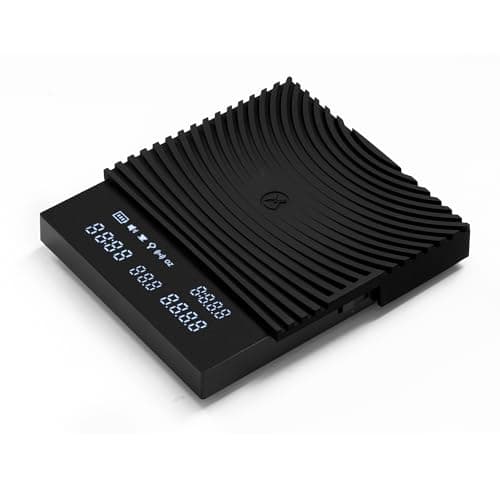 | Anyone buying a Black Mirror now, at either price | Top pick of the two | |
| 2 | 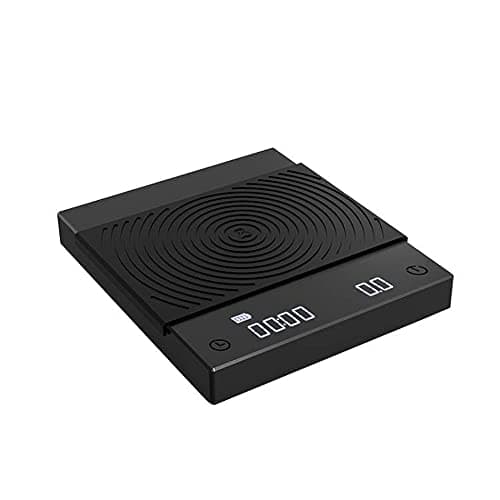 | Someone who finds it meaningfully cheaper than the current model | Buy this only on a discount | |
| 3 | 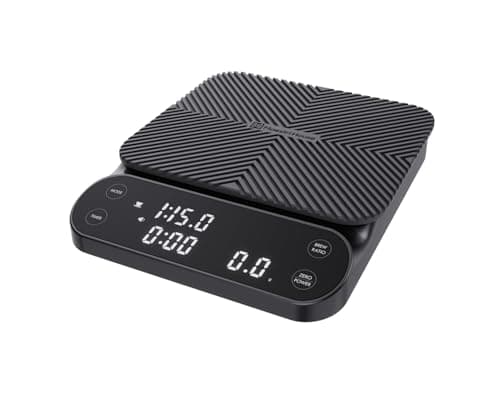 | Anyone who cares about function rather than the Black Mirror name | The scale that undercuts both | |
| 4 | 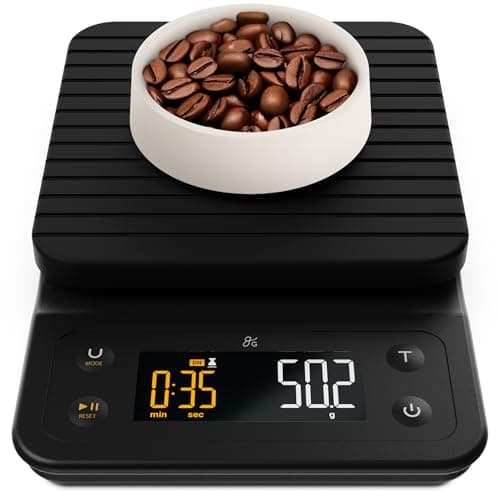 | A first scale, or a second one for the filter station | Cheapest worth owning | |
| 5 | 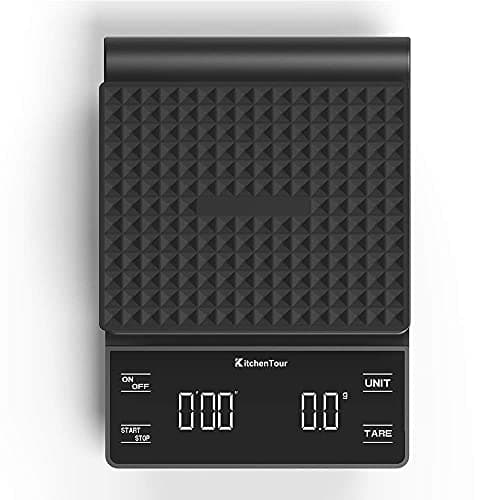 | Weighing beans, not brewing with | Skip this one |
1. Top pick of the two
Timemore Black Mirror Basic 3.0
Entry tier · The current Black Mirror: adds a live brew-ratio readout and three brewing modes.
Adds a live brew-ratio readout and three brewing modes for a small premium.
Between these two generations the Basic 3 is the one to buy, and the reason is the brew-ratio readout rather than anything about precision.
Both scales read to 0.1 g with a 2 kg capacity, and both show weight, a timer and flow rate. The Basic 3 adds a live brew ratio, which removes the one calculation people get wrong while simultaneously watching a clock and a cup.
It also adds three brewing modes - regular, pour-over and espresso. The espresso mode is the practically useful one: it times the shot from the drip tray without a button press, which matters because during a shot your hands are busy.
Retailers publish a lower minimum detection for it, 0.2 g against the Basic 2's 0.5 g, and an IPX3 splash rating with a static shield that the older model does not list. Both figures come from retailers rather than from Timemore.
The honest caveats: it costs a little more for the same resolution and capacity, three modes is three things to be in the wrong one of, and Timemore publishes no spec sheet comparing the two generations - so the differences above are assembled from listings and retailers, not from a manufacturer document.
Specification
- Resolution
- 0.1 g
- Capacity
- 2 kg
- Readouts
- Weight, timer, flow rate and brew ratio
- Modes
- Three brewing modes (regular, pour-over, espresso)
- Battery
- Rechargeable, USB-C
- Minimum detection
- Retailers publish 0.2 g
- Splash rating
- Retailers publish IPX3
What it does well
- The live brew-ratio readout removes the one calculation people get wrong
- Espresso mode times the shot off the drip tray without a button press
- Retailers publish a lower minimum detection and an IPX3 splash rating
Where it gives ground
- Costs a little more than the Basic 2 for the same resolution and capacity
- Three modes is three things to be in the wrong one of
- Timemore does not publish a manufacturer spec sheet comparing it with the Basic 2
Skip it if
Skip it if you find the Basic 2 substantially discounted and you are happy doing ratio arithmetic in your head.
2. Buy this only on a discount
Timemore Black Mirror Basic 2
Entry tier · The previous-generation Black Mirror: weight, timer and flow rate, with no ratio display.
The same 0.1 g resolution, timer and flow rate - without the ratio display.
The Basic 2 is not a worse scale in the ways that matter most. It reads 0.1 g to a 2 kg capacity, has an auto timer and a flow-rate function, runs on a 1600 mAh rechargeable battery and switches between grams and ounces.
For dialing in espresso or brewing pour-over, those are the functions you actually use. Dose in, liquid out, time elapsed.
What it does not do is calculate the ratio for you, which means you are dividing 36 by 18 in your head while watching a shot. That is not difficult; it is one more thing happening at once.
Retailers publish a 0.5 g minimum detection against the newer model's 0.2 g. In practice that matters when weighing very small amounts rather than normal doses, so it is a smaller difference than the spec gap suggests.
The decisive point is price. These two generations sit close enough together that the older one is only the right buy when it is genuinely discounted - at near-identical money there is no argument for it, and no published splash rating either.
Specification
- Resolution
- 0.1 g
- Capacity
- 2 kg
- Readouts
- Weight, auto timer, flow rate
- Battery
- 1600 mAh, USB rechargeable
- Units
- Grams and ounces
- Minimum detection
- Retailers publish 0.5 g
What it does well
- Flow rate and an auto timer at the cheaper end of the Black Mirror line
- 0.1 g resolution and 2 kg capacity match the newer model
- Still widely stocked, so it is easy to replace if one dies
Where it gives ground
- No brew-ratio display - you do the arithmetic
- Retailers publish a 0.5 g minimum detection against 0.2 g on the Basic 3
- No splash rating published, where the Basic 3 lists IPX3
Skip it if
Skip it at full price. At the same money the Basic 3 gives you the ratio readout and the modes for nothing.
3. The scale that undercuts both
Maestri House S3 Coffee Scale
Budget tier · A rechargeable coffee scale with brew modes, ratio targets and a flow-rate display.
More published features than either Timemore, for less money.
This is the comparison the Black Mirror line has to survive, and it is uncomfortable. The Maestri House S3 publishes a longer feature list than either Timemore here, at a lower price.
It reads 0.1 g to a 3000 g capacity - a third more headroom than the Timemore's 2 kg - with auto-timer modes for pour-over and espresso plus a standard mode, a real-time flow-rate display, and an adjustable brew ratio from 1:1 to 1:18 that alerts when you hit the target.
That ratio-with-alert function is a step beyond the Basic 3's ratio readout: it tells you when to stop rather than asking you to watch a number.
It also publishes IPX4 water resistance - a step above the IPX3 retailers list for the Basic 3 - and a 500 mAh battery rated up to 90 days.
What you give up is the Black Mirror's build reputation and its slim profile, which is a genuine consideration if the scale has to live permanently on a drip tray. Timemore's fit and finish is the reason people pay the difference, and that is a preference rather than a specification.
Specification
- Capacity
- 3000 g
- Resolution
- 0.1 g
- Modes
- Auto timer for pour-over, auto timer for espresso, standard
- Ratio
- Adjustable 1:1 to 1:18, alerts at target
- Flow rate
- Real-time display
- Battery
- 500 mAh, up to 90 days
- Water resistance
- IPX4
What it does well
- Auto-start timers for pour-over and espresso
- Ratio mode calculates the target water weight from your dose
- Rechargeable, with a battery rated for about 90 days
Where it gives ground
- More modes means more menus than a basic scale
- IPX4 resists splashes, not immersion
- Flow-rate readouts only help if you know what to do with them
Skip it if
Skip it if the scale must be as thin as possible to fit under your group head, or if you want the Timemore build.
4. Cheapest worth owning
Greater Goods Coffee Scale with Timer
Budget tier · A 0.1 g coffee scale with a timer, physical buttons and a protective silicone cover.
0.1 g with a five-year warranty, if the budget is the constraint.
If the question is simply how to get a usable coffee scale for the least money, this is the answer rather than either Timemore.
It reads 0.1 g with a published 0.3 g minimum, to a 3000 g capacity, with a count-up and count-down timer, physical buttons rather than touch keys, and six unit options.
Physical buttons are an underrated advantage on a wet counter, where touch keys misread. It also ships with a heat-resistant, dishwasher-safe silicone cover - genuinely useful on a scale that will have hot water spilled on it.
The five-year warranty is unusual at this price and is the strongest argument for it over an unbranded scale.
There is no flow rate, no brew ratio and no espresso mode, and it auto-offs after two minutes idle - which is short enough to catch you mid-brew. It is the basic tool done properly rather than a brewing instrument.
Specification
- Capacity
- 3000 g
- Resolution
- 0.1 g; minimum 0.3 g
- Timer
- Count-up and count-down
- Units
- 6
- Cover
- Heat-resistant, dishwasher-safe silicone
- Auto-off
- After 2 minutes idle
- Warranty
- 5 years
What it does well
- Physical buttons work reliably with wet fingers
- The silicone cover protects the platform from spills and hot kettles
- A 5-year warranty is unusual at this price
Where it gives ground
- No ratio or flow-rate display, which the Maestri House S3 has
- Built for general kitchen use as much as coffee
- Larger than a dedicated espresso scale
Skip it if
Skip it if you want flow rate or a ratio display. It does weight and time, well, and nothing else.
5. Skip this one
KitchenTour Coffee Scale with Timer
Budget tier · A backlit coffee scale whose 0.1 g resolution applies only up to 500 g.
Its 0.1 g resolution only applies up to 500 g - read the specification carefully.
This scale is on the page as the trap in this category, and the issue is a specification people do not read closely.
Its resolution is tiered: 0.1 g only from 0.3 to 500 g, then 0.5 g up to 1000 g, then 1 g up to 3000 g. The headline '0.1 g, 3000 g capacity' is true and misleading at the same time.
For coffee that tiering is mostly survivable, because a dose plus a cup usually stays under 500 g. But put a heavier carafe or a mug on it and you drop to 0.5 g steps without being told, which is precisely when you stop being able to trust a pour-over yield.
It has a backlit LCD, a built-in timer, touch-sensitive keys and a waterproof non-slip silicone pad, so it is not a badly made object - the problem is the specification rather than the build.
Touch keys on a wet counter are also a recurring annoyance. If the budget is this tight, the Greater Goods scale holds 0.1 g across a far wider range for a similar price - see best coffee scales under $50.
Specification
- Capacity
- 3000 g
- Resolution
- 0.1 g from 0.3-500 g; 0.5 g to 1000 g; 1 g to 3000 g
- Timer
- Built in
- Controls
- Touch-sensitive keys
- Display
- Backlit LCD
- Pad
- Waterproof non-slip silicone
What it does well
- 0.1 g covers every espresso dose and a typical single pour-over
- The backlit display is easy to read over a dripper
- The silicone pad keeps it from sliding on a wet counter
Where it gives ground
- Resolution drops to 0.5 g above 500 g, which matters for large batches
- Touch keys are less reliable with wet fingers than buttons
- No ratio or flow-rate features
Skip it if
Skip it for brewing. It is fine for weighing beans into a hopper and poor for weighing a yield in a heavy vessel.
Why the ratio readout is the real upgrade
Espresso and pour-over are both ratios: so much coffee in, so much liquid out. A standard espresso target is 18 g in and 36 g out, which is 1:2; a pour-over might be 1:16.
Doing that division is trivial in isolation and awkward in the moment, because you are doing it while watching a timer, a rising weight and a shot that is changing color. The scale calculating it live removes the step most likely to be fumbled, and it makes a deviation obvious instantly rather than after the fact.
The espresso mode matters for a related reason: it starts timing when liquid hits the tray, so you do not have to press anything with a portafilter in your hands. On the general method, how to dial in espresso is the page, and dialing in on a Breville Bambino is the version for a machine with no gauge.
A scale is not where the money should go first
Keep this in proportion. Any 0.1 g scale that fits on your drip tray makes your coffee repeatable, and the difference between the two generations here is a convenience feature.
If you are choosing between spending the difference on a scale upgrade or on the grinder, the grinder wins every time - it sets the ceiling on the cup and a scale only measures it. How to choose a coffee grinder is the more consequential decision, and best coffee scales for espresso covers the wider field including scales with app connectivity.