The short answer
It is worth it if counter space or a one-button morning matters more to you than grind quality, and if the machine inside has a burr grinder rather than a blade. It is not worth it if you already own a grinder, if you brew several ways, or if you expect the machine to last - a combined unit puts two failure points in one enclosure, and neither half can be replaced alone.
What you gain
- One appliance instead of two, which is a real difference in a small kitchen.
- One action instead of three. Beans in, button, coffee - no weighing, no transferring.
- Programmability with fresh grind. A machine that grinds at 6:30 for a 6:31 brew is genuinely better than one brewing coffee ground the night before.
- A lower total price than a good grinder plus a certified brewer.
What you give up
Grind resolution. Eight settings on the best of these machines against 40 on an entry standalone grinder. Drip brewing tolerates that better than espresso would, but it still means adjusting in large jumps.
Grinder quality at the cheap end. Several popular grind-and-brew machines use blade grinders. A blade chops for a set time rather than cutting to a size, which produces dust and chunks in the same batch.
Serviceability. When a grinder motor or a chute fails in a combined machine, the brewer fails with it. A standalone grinder can be repaired or replaced without touching the brewer.
Cleaning. Coffee grounds are oily and static-prone. A built-in grinder means chutes and burrs inside the same box that holds the water path, and owners consistently report that as the maintenance they did not expect.
The question that settles it
Do you already own a burr grinder? If yes, a combined machine is a downgrade wearing a convenience badge - you would be buying a second, weaker grinder and giving up the one you have.
If no, the honest comparison is a combined machine against a grinder plus a certified brewer at a similar total. Separates win on quality and longevity; the combined machine wins on space and on the number of things you touch before coffee.
There is a third answer worth naming: buy the brewer now and the grinder later. A certified brewer fed with coffee ground at the shop is still a better cup than an uncertified machine with a blade grinder inside it, and the upgrade path stays open rather than being sealed in a case.
Quick picks
The answer first. Tap any row to jump to the full reasoning for that pick.
| # | Product | Best for | Award | Price |
|---|---|---|---|---|
| 1 | 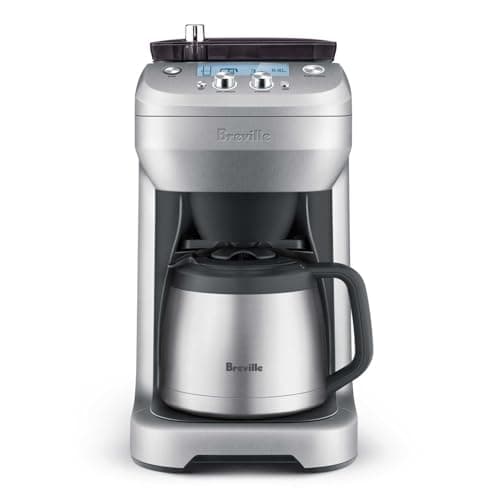 | People who want one box and will use the range | The best version of the idea | |
| 2 | 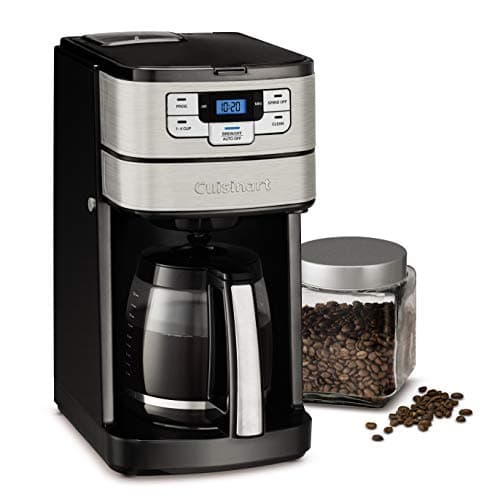 | Convenience first, at the lowest price | The cheap version, and its catch | |
| 3 | 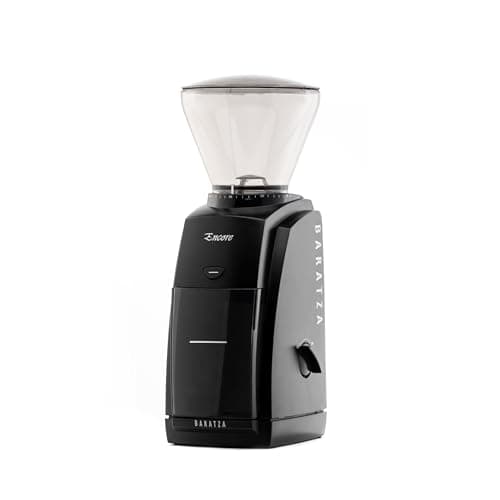 | Anyone willing to press two buttons instead of one | The separates answer |
1. The best version of the idea
Breville Grind Control
Mid tier · A drip brewer with a burr grinder built into the case.
A real burr grinder inside, 8 grind settings, and 5 to 60 oz from the same hopper.
The Grind Control has a stainless steel burr grinder built into the case - a burr, not a blade, which is the first question to ask of any grind-and-brew machine.
It brews 5 to 60 oz, so a single cup and a full carafe come from the same machine and the same hopper. Few machines in this category manage both.
The hopper holds half a pound and is removable with a locking system, so you can swap beans without emptying it - the sensible answer to a hopper's usual problem.
Eight grind settings is coarse control. For drip brewing that is survivable, because the useful drip range is narrow, but it is not the resolution a standalone grinder gives you.
It also means cleaning two machines in one enclosure: grounds chutes and burrs need attention that a plain brewer does not.
Specification
- Grinder
- Built-in stainless steel burr, 8 grind settings
- Strength
- 8 settings
- Brew range
- 5-60 oz
- Carafe
- 60 oz insulated stainless
- Hopper
- Half a pound, removable with a locking system
What it does well
- Whole beans to brewed coffee with one button
- Brews a single cup or a full carafe from the same hopper
- Removable hopper means you can swap beans without emptying it
Where it gives ground
- Grinding and brewing in one box means cleaning two machines in one
- 8 grind settings is coarse control
- A separate grinder and brewer beats it on both counts for a similar total
Skip it if
Skip it if you already own a burr grinder. You would be paying for a weaker second one.
2. The cheap version, and its catch
Cuisinart Automatic Grind & Brew DGB-400
Budget tier · A 12-cup drip machine with a blade grinder built in - not a burr grinder.
Whole beans to brewed coffee at the lowest price - with a blade grinder inside.
The DGB-400 brews 12 cups with a grinder built in, programs 24 hours ahead, and has a grind-off mode for pre-ground coffee.
The grinder is a blade, not a burr. It chops beans for a set time rather than cutting them to a size, which produces dust and boulders together.
In a drip basket that mixture extracts unevenly: the dust over-extracts into bitterness while the boulders barely extract at all, in the same cup.
It publishes no brew-temperature figure and carries no SCA certification, so what happens after grinding is unverified too.
At 9.98 x 8.13 x 15.5 in it is compact for a machine with a grinder inside, and the grind-off mode means you can bypass the blade entirely - which is, in effect, the recommendation.
Specification
- Capacity
- 12 cups
- Grinder
- Blade grinder, not burr
- Programming
- 24-hour brew start, adjustable auto-off, 1-4 cup setting
- Options
- Brew Pause; grind-off for pre-ground coffee
- Dimensions
- 9.98 in W x 8.13 in D x 15.5 in H
What it does well
- Whole beans to brewed coffee at the lowest price in the category
- Grind-off mode lets you use pre-ground coffee instead
- Compact for a machine with a grinder inside
Where it gives ground
- The grinder is a blade, which chops rather than cuts to a size
- Blade grinding produces dust and boulders together, which extract unevenly
- No published brew-temperature figure and no SCA certification
Skip it if
Skip it if grind quality matters to you at all - see burr grinder vs blade grinder.
3. The separates answer
Baratza Encore
Entry tier · The standard entry burr grinder for filter brewing.
A serviceable 40 mm conical grinder that outlives whatever brewer you pair it with.
The Encore grinds on 40 mm conical burrs across 40 stepped settings covering 250 to 1200 microns - the entire filter range at real resolution.
Its burr speed of roughly 450 to 550 rpm keeps heat and static down, which is what keeps grounds in the basket rather than on the counter.
Baratza sells parts individually and publishes repair guides, so the grinder is repairable for years. A grinder built into a brewer is not, in any practical sense.
Pairing it with a certified brewer costs more than a combined machine and gives you both halves done properly, plus the freedom to replace either one.
It is one more object on the counter and one more button in the morning. That is the whole price of separates - see the Baratza Encore review.
Specification
- Burrs
- 40 mm conical, made in Europe
- Settings
- 40 stepped
- Grind range
- 250-1200 microns
- Burr speed
- Roughly 450-550 rpm to limit heat and static
What it does well
- The reference answer for pour-over, drip and French press
- Fully serviceable, with parts sold individually for years
- Low burr speed keeps static and heat down
Where it gives ground
- Bottom of its range is too coarse for espresso - that is the ESP model job
- Stepped settings only
- Plastic body and a loud motor
Skip it if
Skip it if counter space genuinely does not exist. That is the one argument combined machines win outright.
Burr or blade - the only specification that decides it
Scroll the table sideways to see every column.
If you buy one, buy it like this
- Confirm it is a burr grinder. If the listing does not say burr, it is a blade.
- Check the brew range. Machines optimized for a full carafe brew badly at one cup.
- Look for a removable hopper, so beans can be swapped without emptying it.
- Read what cleaning involves before buying, not after the first month.