The short answer
Buy the Braun BrewSense KF6050. It is the only machine here that treats hard water as a feature: Braun states an integrated charcoal filter purifies the brewing water, and that the cleaning cycle can be customized to match your local water hardness level. Breville's Luxe Brewer is the alternative, with a named Claro Swiss filter in a removable 60 oz tank you can fill from a filter jug. But no brewer removes scale - only a descaler does, and Urnex Dezcal states it is more effective and faster than vinegar and odorless, dosed at 1 oz per 32 oz of reservoir. In very hard water, a manual brewer has no element to scale at all.
Hard water causes two separate problems
The first is in the cup. Dissolved minerals change how coffee extracts, and heavily mineralized water produces a flat, muted brew that tastes under-extracted however you adjust the grind. No coffee maker fixes this, because the minerals are in the water before the machine sees it. Only filtration or a different water source changes it.
The second is in the machine, and it is the one people notice later. Scale deposits on the heating element and inside the water path, and Urnex states the consequence plainly: scale prevents machines from reaching optimal water temperatures. So the second symptom of hard water is also flat coffee - this time because the brew is now happening ten or fifteen degrees cooler than the machine intends. People chase that for months with grind adjustments.
A very short list publishes a water filter
We checked the makers' own published copy for every drip machine in this site's registry. Three state a built-in water filter: Braun names an integrated charcoal filter, Breville names a Claro Swiss filter integrated into the removable tank, and Cuisinart names a built-in charcoal water filter. That is the list.
Several machines include a gold-tone or permanent COFFEE filter, which is a different thing entirely - it filters the brewed coffee, not the incoming water, and does nothing about minerals. The two get conflated in product copy constantly, and it is worth reading which one a listing is actually claiming. Technivorm and BUNN publish no water filter at all.
Quick picks
The answer first. Tap any row to jump to the full reasoning for that pick.
Prices shown are checked daily against the retailer, as of November 9, 2026. We never write a price into the text of a page.
| # | Product | Best for | Award | Price |
|---|---|---|---|---|
| 1 | 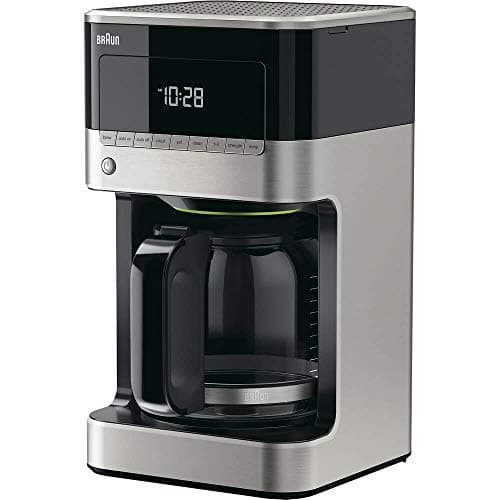 | Hard water you have to live with rather than treat | Top pick | |
| 2 | 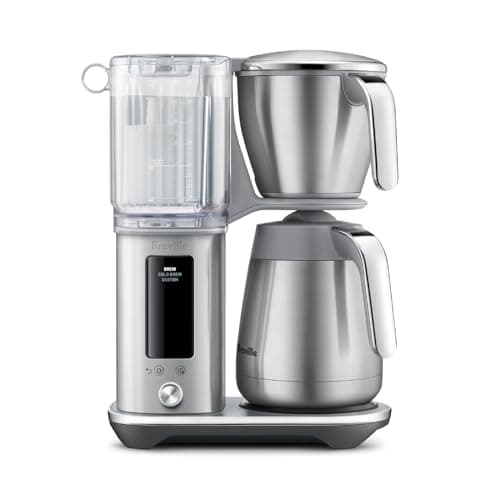 | Filtering at the tank, and refilling it at a tap you choose | Best filtered tank | |
| 3 | 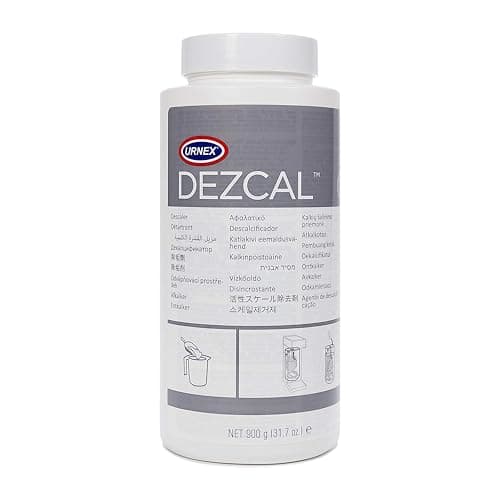 | Every machine you already own, whatever it is | The thing that actually fixes it | |
| 4 | 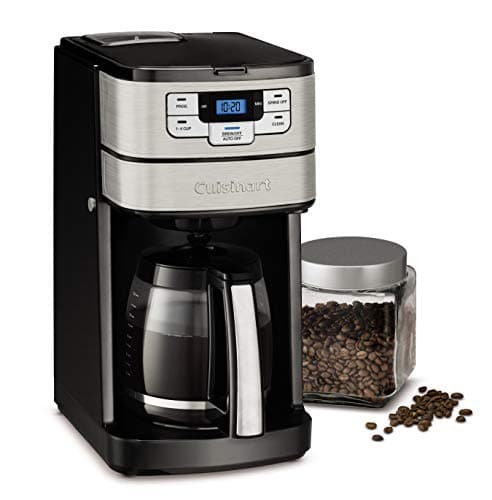 | Filtered brewing water without spending much | Best budget filtered machine | |
| 5 | 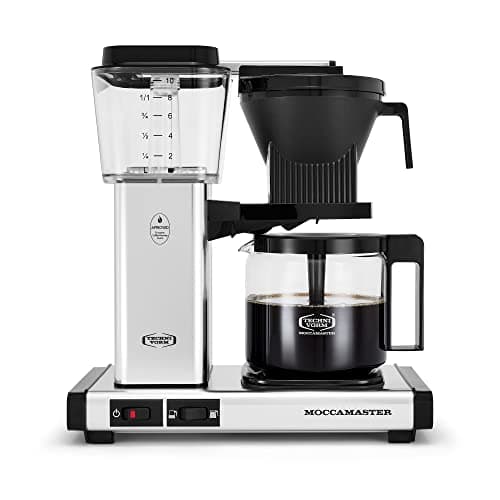 | Hard water over ten years rather than one | Best built to be descaled | |
| 6 | 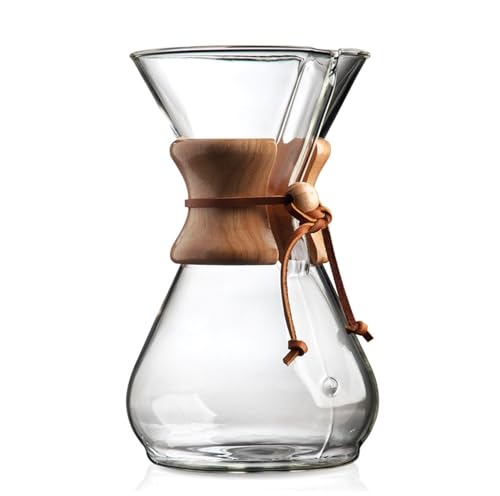 | Very hard water, or a machine you refuse to maintain | Best way to sidestep it entirely | |
| 7 | 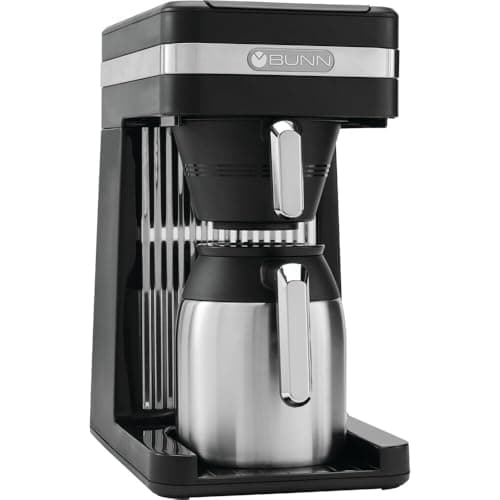 | Soft water, where it is excellent | Skip this one, in hard water |
1. Top pick
Braun BrewSense KF6050
Budget tier · A programmable drip machine with a permanent gold-tone filter.
The only machine here whose descaling cycle is set to your local water hardness.
This is the top pick because Braun is the only maker on this page that addresses hard water as a feature rather than leaving it in the manual.
Braun states that an integrated charcoal filter actively purifies the brewing water - so the filtration is inside the machine, in the path, on every brew, rather than depending on you remembering to fill a filter jug first.
The decisive part is the second claim. Braun states that the smart cleaning features can be customized to match your local water hardness level, which means the machine's descaling reminder is calibrated to your water instead of a generic interval. In hard water a generic interval is always wrong, and it is wrong in the direction of scale.
That matters because scale is not cosmetic. It coats the heating element, and a coated element cannot get the water as hot - so the first symptom of hard water is not a crusty machine, it is coffee that tastes under-extracted for no apparent reason.
It is a 12-cup machine with a 24-hour programmable timer, two brew styles, bold and regular strength and a 1-4 cup setting, plus a gold-tone permanent filter that Braun says lets the coffee oils through. Braun publishes no brew temperature and makes no SCA claim for it, so we are recommending it on the water handling, which is what this page is about.
Specification
- Capacity
- 10 cups / 40 oz; up to 12 x 5 oz cups
- Dimensions
- 7.9 x 7.9 x 14.2 in
- Filter
- Gold-tone permanent filter included
- Programming
- 24-hour timer, brew pause
- Warranty
- 3 years
What it does well
- Permanent filter means no paper cost and more oils in the cup
- Three-year warranty is unusually long in this bracket
- Narrow footprint for a 12-cup machine
Where it gives ground
- Braun does not publish a brew-temperature figure to check
- No SCA certification
- Gold-tone filters let fines through, which shows up with a coarse grinder
Skip it if
Skip it if brew temperature is your priority. For a published temperature figure the machines on the main coffee maker roundup are the ones to read.
2. Best filtered tank
Breville Luxe Brewer Thermal
Upper-mid tier · The Precision Brewer's successor: SCA-approved drip with a saved custom profile and a cold brew mode.
A removable 60 oz tank with a Claro Swiss water filter integrated into it.
Breville takes the opposite approach to Braun and it is arguably the better one: the filter lives in the water tank, and the tank comes out.
Breville states a fully removable 60 fl oz (12 cup) water tank with an integrated Claro Swiss water filter and measuring lines. Naming the filter matters - it means there is a replaceable cartridge with a part to reorder rather than a vague charcoal insert.
A removable tank is a practical advantage in hard water specifically. You can fill it from a filter jug or a different tap entirely, which means the machine's own filter is the second stage rather than the only one. On a fixed-plumbing machine you take what the tap gives you.
The wide lid is a small thing that gets used daily: it takes a jug pour without splashing back, which is exactly how you would refill it if you are pre-filtering.
It also brews cold brew on a preset, ready in up to 30 minutes depending on volume, and ships with both cone and flat-bottom baskets. Breville publishes no wattage or brew temperature on this listing. The thermal carafe is stated to keep coffee warm up to 4 hours.
Specification
- Capacity
- 60 fl oz / 12 cups; 1.8 L reservoir
- Certification
- Golden Standard mode, SCA approved
- Modes
- Golden Standard, Cold Brew, Custom Brew
- Custom control
- Bloom volume, bloom time, brew temperature and flow rate
- Cold brew
- Up to 4 cups (600 ml), steep adjustable from 30 minutes to 36 hours
- Carafe
- Dual-wall thermal; above 150 F / 65 C for up to 4 hours
- Power
- 1650 W
- Size
- 16.1 x 10.2 x 6.8 in
What it does well
- The custom profile exposes bloom volume, bloom time, temperature and flow rate, and remembers them
- Cold brew in as little as 30 minutes, or up to 36 hours if you want a long steep
- A thermal carafe that holds above 150 F for up to four hours, so there is no hotplate
Where it gives ground
- Three modes rather than the longer preset list the Precision Brewer carried
- Breville no longer lists a pour-over adapter for this line
- All of that control is wasted if you only ever press the Golden Standard button
Skip it if
Skip it if you want the simplest possible machine. This is a multi-mode brewer and the filter is one feature among several you are paying for.
3. The thing that actually fixes it
Urnex Dezcal Descaler
Entry tier · A citric-acid descaling powder for removing limescale from boilers and water lines.
A descaling powder dosed by reservoir size, stated to beat vinegar and to be odorless.
No coffee maker removes scale. Filters slow it down; a descaler is the only thing that takes it out, which is why this is on a page about machines.
Urnex states that it is more effective at removing limescale than vinegar, works faster and is odorless. That last point is not trivial - the reason people skip descaling is that a vinegar cycle leaves the machine smelling of vinegar for several brews afterwards, so it gets put off.
It is explicitly universal. Urnex lists Keurig, Nespresso, Breville, Jura, De'Longhi and other drip makers, espresso machines, superautomatics and kettles. One bottle covers the brewer, the kettle and the espresso machine rather than three products.
Dosing is stated rather than guessed: 1 oz of powder per 32 oz of your machine's reservoir capacity. The 900 g bottle is therefore many cycles, which is the right format for hard water where the interval is short.
Urnex also states the reason to bother, and it is the one people miss: scale prevents machines from reaching optimal water temperatures. Descaling is a flavor intervention before it is a maintenance one.
Specification
- Job
- Descaling - removes mineral scale
- Composition
- Citric acid, sulfamic acid, aluminum sulfate; phosphate-free
- Safe on
- Brass, stainless and aluminum internals
- Applies to
- Any machine that heats water
What it does well
- Does the job vinegar is wrongly used for, without attacking seals or leaving a smell
- Phosphate-free and safe across the metals used in home machines
- Every machine that heats water needs this eventually - it is not optional
Where it gives ground
- Descaling frequency depends on your water, so the pack size you need varies
- Requires a thorough rinse afterwards or the next few drinks taste of it
- Does nothing about coffee oils - that is a different product
Skip it if
Skip it only if you have no heating element anywhere - a Chemex and a press never need it. For espresso machines specifically, the cleaning kits page covers backflushing as well.
4. Best budget filtered machine
Cuisinart Automatic Grind & Brew DGB-400
Budget tier · A 12-cup drip machine with a blade grinder built in - not a burr grinder.
A built-in charcoal water filter and a permanent gold-tone coffee filter, cheaply.
If the goal is simply to get a charcoal filter into the water path for as little as possible, this is the machine that does it.
Cuisinart states a built-in charcoal water filter alongside a permanent gold-tone coffee filter - two filters doing two different jobs, one on the water going in and one on the coffee coming out.
It is a 12-cup grind-and-brew with a 24-hour programmable timer, so the beans are ground at the start of the cycle. For a household where the coffee maker is a background appliance rather than a hobby, that combination of fresh grinding and filtered water covers most of what actually affects the cup.
The grinder is a blade grinder rather than a burr set, which we are not going to pretend is a feature - but it is fresher than a bag of pre-ground coffee that has been open a fortnight, and on this page the water is the subject.
It uses a glass carafe on a hot plate, so the pot should be poured out rather than left to stew, and Cuisinart publishes no brew temperature. The charcoal filter is a consumable with a replacement cost.
Specification
- Capacity
- 12 cups
- Grinder
- Blade grinder, not burr
- Programming
- 24-hour brew start, adjustable auto-off, 1-4 cup setting
- Options
- Brew Pause; grind-off for pre-ground coffee
- Dimensions
- 9.98 in W x 8.13 in D x 15.5 in H
What it does well
- Whole beans to brewed coffee at the lowest price in the category
- Grind-off mode lets you use pre-ground coffee instead
- Compact for a machine with a grinder inside
Where it gives ground
- The grinder is a blade, which chops rather than cuts to a size
- Blade grinding produces dust and boulders together, which extract unevenly
- No published brew-temperature figure and no SCA certification
Skip it if
Skip it if you own a burr grinder. Buy a brewer without a grinder in it instead - is a coffee maker with a built-in grinder worth it makes the case.
5. Best built to be descaled
Technivorm Moccamaster KBGV Select
Upper-mid tier · A hand-assembled drip brewer certified by the SCA, with a copper heating element.
Pump-free, one switch, a five-year warranty and parts sold individually.
The other way to survive hard water is to buy a machine designed to be maintained, and this is the one on the page built that way.
Technivorm states it is pump-free and heats water to the correct temperature for extraction. Fewer moving parts in the water path means fewer places for scale to accumulate somewhere you cannot reach, which is the failure that ends most drip machines.
It carries a five-year warranty and Technivorm sells parts individually rather than replacing the machine. In hard water that is the difference between a machine that is descaled for a decade and one that is thrown away in three.
The specification is plain and published: 40 oz in four to six minutes, a brew-volume selector for half or full carafes, and automatic shut-off after 100 minutes. The half-carafe setting matters here because brewing the right amount means less water through the machine overall.
It has no water filter of any kind, which is the honest trade and the reason it is not the top pick. You filter the water yourself or you descale on a schedule - Technivorm's answer is durability, not filtration.
Specification
- Certification
- SCA Certified Home Brewer
- Brew temperature
- 196-205 F
- Capacity
- 1.25 L / 40 oz / 10 cups
- Brew time
- 4-6 minutes for a full carafe
- Build
- Hand-assembled in the Netherlands, metal and glass
What it does well
- Reaches and holds real brewing temperature, which most drip machines do not
- Every part is replaceable - these get repaired, not landfilled
- Half-carafe setting adjusts saturation time rather than just volume
Where it gives ground
- No timer, no programming, no app
- Tall enough to be awkward under a low cabinet
- Costs more than several espresso machines
Skip it if
Skip it if you want the machine to handle the water for you. There is no filter in it - see is the Moccamaster worth it.
6. Best way to sidestep it entirely
Chemex Classic 10-Cup
Manual tier · The 10-cup Chemex: one borosilicate glass carafe, a wood collar and a leather tie.
No element, no tank, no tubing - so there is nothing for scale to form on.
The complete answer to scale is to own nothing that can scale, and a manual brewer is the only pick here that qualifies.
There is no heating element, no reservoir and no tubing. Scale forms where hard water is heated and held; in a Chemex the water is heated in a kettle you can descale in five minutes and then it is in glass for ninety seconds.
This also moves the problem to the right place. The kettle becomes the only thing in the kitchen that scales, which is the cheapest item to maintain or replace and the easiest to see inside.
Chemex states its carafes are non-porous borosilicate glass that will not absorb odors or chemical residues, so hard water leaves no lasting mark on the brewer itself. The 10-cup holds 50 oz at Chemex's 5 oz per cup.
You are brewing by hand for four to five minutes, and the thick bonded filters are sold separately. In very hard water a paper filter does nothing about mineral content either - the cup will still taste muted, which is the half of this problem no brewer fixes.
Specification
- Capacity
- 10 cups at Chemex's own 5 oz per cup, so 50 oz
- Material
- Non-porous borosilicate glass, stated not to absorb odors or residues
- Collar
- Wood with a leather tie
- Filters
- Chemex Bonded FP-1 / FC-100 / FS-100 / FSU-100, not included
- Model
- CM-10A
- Power
- None - it is a carafe
What it does well
- Brews 50 oz with no plastic and no electricity anywhere in the water path
- Chemex states brewed coffee can be covered and refrigerated for reheating
- Nothing on it can fail, so there is no part to replace and no scale to descale
Where it gives ground
- Filters are sold separately and the thick bonded paper is not interchangeable with cone filters
- 50 oz of pour-over is a real arm workout and takes sustained attention
- Glass, with no handle beyond the collar - it is the breakable option
Skip it if
Skip it if you want unattended coffee. This is a manual pour every time - see the best pour-over coffee makers.
7. Skip this one, in hard water
BUNN CSB3T Speed Brew Platinum Thermal
Mid tier · The Speed Brew with a vacuum-insulated carafe instead of a warmer plate.
A great fast brewer, and a permanently heated 70 oz tank is the worst case for scale.
This is a machine we recommend warmly elsewhere, and in hard water it is the one configuration on this page that works against you.
BUNN's design keeps 70 oz of water permanently hot in an internal stainless steel tank, which is exactly why it brews a 50 oz carafe in four minutes. It is also exactly the condition in which scale forms: hot water, held, continuously.
A machine that heats water only during a brew cycle spends most of the day with cool water in it. This one never does. In soft water that costs nothing; in hard water it compounds every day the machine is plugged in.
There is no water filter in the line either, so nothing slows the mineral load before it reaches the tank.
The fix, if you own one and your water is hard, is not to replace it - it is to descale it on a short interval with a universal descaler and to consider filling it from filtered water. On the crowd page it is the top pick, because speed is what that page is about.
Specification
- Brew time
- A full 50 oz carafe in 4 minutes
- Tank
- Keeps 70 oz of water always hot
- Tank temperature
- Not published by BUNN
- Brew temperature
- Not published by BUNN for the Speed Brew line
- Carafe
- 50 oz vacuum-insulated double-walled thermal; BUNN says it holds serving temperature 2+ hours
- Warmer
- None listed - the carafe does the work
- Warranty
- 3 years
What it does well
- No hot plate anywhere, so brewed coffee is never sat on a heater
- BUNN rates the carafe at 2+ hours at serving temperature
- Same four-minute brew as the rest of the Speed Brew line
Where it gives ground
- Thermal carafes pour slower and are harder to clean than glass
- Still no published brew temperature and still no clock
- Costs more than the glass-carafe Elite for the same brewing
Skip it if
Skip it in hard water unless you will descale frequently. In soft water it is the fastest brewer we cover - see the BUNN guide.
What each maker actually states about water
Scroll the table sideways to see every column.
The order to do this in
- 1Descale what you already own, now. If you have never done it and your water is hard, this single step will change how your coffee tastes more than a new machine will. Dose by your reservoir size rather than by eye.
- 2Then decide where to filter. A machine with an integrated filter does it for you on every brew. A removable tank lets you pre-filter and use the machine's filter as a second stage. Both beat remembering to fill a jug.
- 3Then set an interval and keep it. In hard water the right interval is shorter than the manual's default, which is why a machine that calibrates its reminder to your hardness is worth paying for.
- 4Only then consider the brewer. If your water is severe enough that this is a recurring battle, a manual brewer plus a descaled kettle removes the machine from the equation entirely.
What we are not going to tell you
We are not going to give you a target water hardness in parts per million, a mineral recipe or a filter cartridge comparison, because none of those come from a source we can read off a maker's own documentation. Every claim on this page is something a manufacturer states about its own product.
What we will say is that softened water is not automatically better for coffee - ion-exchange softening replaces hardness minerals with sodium, and coffee brewed with it is its own kind of flat. If your house is on a softener, the kitchen cold tap is often plumbed around it, and that is the tap to fill from.