The short answer
Buy the Magnifica Evo if you want a bean-to-cup machine that still lets you change something - 13 grind settings and a small-hole brew basket that builds more body. Buy the Anima if the appeal is simplicity: ceramic burrs, an Ulka pump and one button per drink. Neither lets you control dose, yield or shot time, because no super-automatic does.
What you are actually buying in this category
A super-automatic replaces every manual step: it grinds, doses, tamps, brews and ejects the puck. Nothing is measured by you, and nothing is adjustable mid-shot.
That is genuinely the right trade for a lot of households. It is also why these machines have a fixed ceiling - see best super-automatic espresso machines for the category in full.
Where they differ
Scroll the table sideways to see every column.
Burr material is not the headline people think
Ceramic burrs run cooler and resist wear; steel burrs are easier to make sharp and are what most grinders use. In a machine that grinds a single 7 to 9 g dose at a time, neither is the limiting factor.
What does matter is grind adjustment. Thirteen settings on the De'Longhi gives you something to change when the coffee tastes thin; a machine with fewer does not.
Both grinders are also sized for a single 7 to 9 g dose rather than an 18 g double, which is part of why bean-to-cup espresso is lighter in the cup than a portafilter shot at the same beans and roast.
Quick picks
The answer first. Tap any row to jump to the full reasoning for that pick.
| # | Product | Best for | Award | Price |
|---|---|---|---|---|
| 1 | 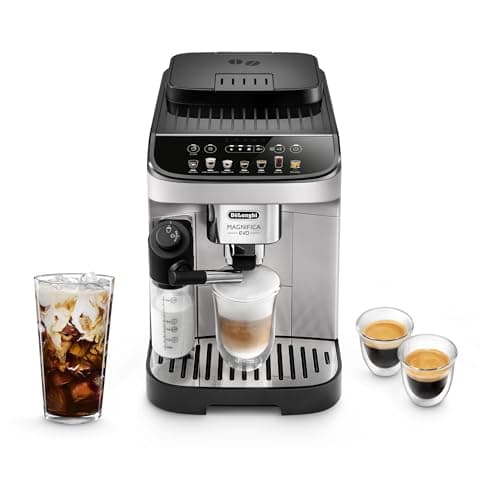 | A bean-to-cup machine you can still adjust | If you want some control | |
| 2 | 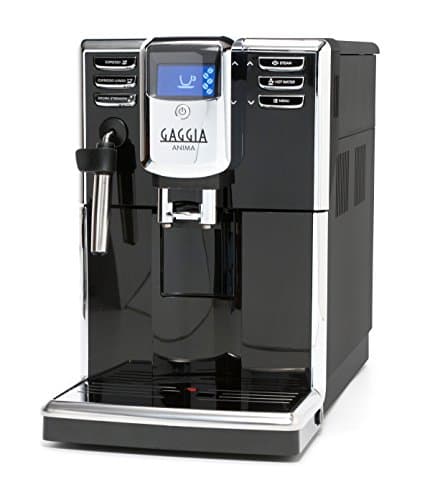 | Push one button, get coffee | If you want the simplest machine |
1. If you want some control
De Longhi Magnifica Evo
Upper-mid tier · A bean-to-cup machine that grinds, doses, tamps and brews at a button press.
Steel conical burrs with 13 grind settings and a small-hole brew basket.
The Magnifica Evo grinds, doses, tamps and brews at a button press using a steel conical burr with 13 grind settings - more adjustment than most machines in this class offer.
Its brew unit uses a small-hole basket, which builds more body in the cup than the typical super-automatic. That is the single biggest quality difference between bean-to-cup machines.
One-touch means no portafilter, no tamping and no cleanup between drinks - the reason people buy this category at all.
You still cannot control dose, yield or shot time; the machine decides all three. The ceiling is fixed by the sealed brew unit.
Grinder and brew group both need regular cleaning, and neglecting it degrades the cup quietly rather than obviously.
Specification
- Grinder
- Steel conical burr, 13 settings
- Format
- Super-automatic, bean to cup
What it does well
- Genuinely one-touch - no portafilter, no tamping, no cleanup between drinks
- 13 grind settings is more adjustment than most super-automatics offer
- Its brew unit uses a small-hole basket, which builds more body than most machines in the class
Where it gives ground
- You cannot control dose, yield or shot time - the machine decides all three
- A sealed brew unit means the ceiling is fixed and cannot be raised
- Grinder and brew group both need regular cleaning or the cup degrades quietly
Skip it if
Skip it if you want the simplest possible machine. Its extra settings are extra things to get wrong.
2. If you want the simplest machine
Gaggia Anima
Upper-mid tier · A minimal push-button bean-to-cup machine with a ceramic burr grinder.
Ceramic burrs, an Ulka 15 bar pump and a button per drink.
The Anima is the minimal end of bean-to-cup: a ceramic burr grinder, an Ulka 15 bar vibration pump, and an interface that is a button per drink.
Ceramic burrs and Ulka pumps are the same parts used across Italian machines, which makes service predictable.
It is compact for a bean-to-cup machine, which matters because this category is usually large.
It offers fewer drink presets than the De'Longhi or the Philips, and no more control over the shot - the fundamental super-automatic limit applies here too.
It starts above the price of a good manual machine plus a grinder, which is the comparison worth making before buying either of these.
Specification
- Grinder
- Ceramic burr
- Pump
- Ulka 15 bar vibration pump
- Format
- Super-automatic, bean to cup
What it does well
- The simplest interface in the category - push a button, get a drink
- Ceramic burrs and an Ulka pump are the same parts used across Italian machines
- Compact for a bean-to-cup machine
Where it gives ground
- Fewer drink presets than the Philips or De Longhi
- Same fundamental limit as every super-automatic: no control over the shot
- Starts higher than the entry price of a good manual machine plus grinder
Skip it if
Skip it if you want milk-drink variety at a button. The Magnifica Evo and Philips offer more presets.
Running costs and the cleaning cycles
Both machines have a sealed brew unit that needs periodic cleaning, plus descaling on the same schedule as any pump machine. De'Longhi and Gaggia both sell branded tablets and descaler for the job, and both machines prompt for it.
That prompting is the important part. On a manual machine a neglected group head is obvious - the puck is sloppy and the shots taste stale. On a bean-to-cup machine the same neglect is invisible: the brew unit accumulates oils, the cup slowly flattens, and most owners blame the beans.
Milk systems compound it. Any machine that pipes milk needs its lines flushed after each session, not weekly, and skipping it is both a flavor and a hygiene problem.
Budget for tablets, descaler and filters as an ongoing cost, the way you would budget for capsules on a pod machine - see what an espresso machine actually costs to own.
The comparison neither maker wants you to make
Both of these cost more than a capable manual machine plus a standalone grinder. That pairing gives you real control, a better grinder, and two devices that can be replaced independently.
The super-automatic wins on one axis only, and it is a big one: nobody has to learn anything. If that is the requirement in your house, it is the right purchase - see how to choose an espresso machine.
Which one is yours
- You want to adjust the grind when the cup is off: the Magnifica Evo.
- You want the fewest possible decisions: the Anima.
- Body in the cup matters: the Magnifica Evo's small-hole brew basket.
- Counter space is tight: the Anima is compact for the class.
- You would rather learn espresso: neither - see best espresso machines for beginners.