The short answer
A first grinder needs three things: burrs rather than blades, a range that covers how you actually brew, and settings you can return to. The Baratza Encore is the default answer for filter coffee, the Timemore C3 is the cheapest one that is not a compromise, and the Encore ESP is the version to buy if an espresso machine is anywhere in your plans. A blade grinder is the purchase to avoid at any price.
What to look for in a first grinder
- Burrs, not blades. Burrs cut to a size; blades chop for a duration. This is the only non-negotiable on the list.
- A range that matches your brewer. Filter brewing needs roughly 250 to 1200 microns. Espresso needs finer than 250 and small steps - if that is coming, buy for it now.
- Settings you can write down. A number you can return to is what makes a change deliberate instead of accidental.
- Capacity that matches your dose. One cup is 15 to 20 g; a carafe is 50 to 60 g. A hand grinder is fine for the first and tedious for the second.
- A repair path. Grinders wear. Parts sold individually mean a five-year purchase becomes a fifteen-year one.
What a beginner does not need
A big hopper. Beans go stale in it. Unless you drink half a pound a week, it is storage for coffee you are slowly ruining.
Sixty settings. What matters is how far each setting moves the burrs, not how many there are. Forty well-spaced steps beat sixty crowded ones.
A timer. Timed dosing drifts as beans age and change density. A cheap scale is more accurate and more useful - see best coffee scales.
Espresso resolution you will not use. If you brew filter and always will, paying for 20-micron clicks buys nothing.
Quick picks
The answer first. Tap any row to jump to the full reasoning for that pick.
| # | Product | Best for | Award | Price |
|---|---|---|---|---|
| 1 | 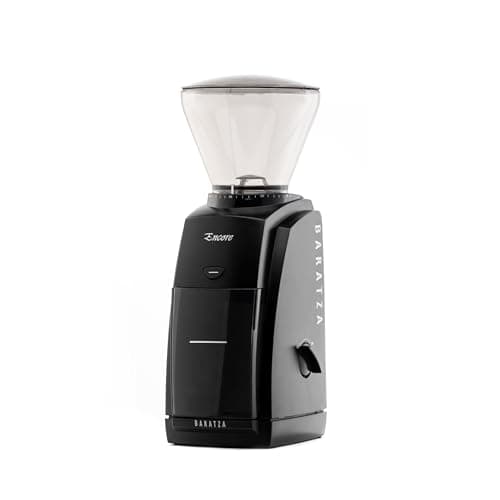 | A first electric grinder for filter coffee | Top pick | |
| 2 | 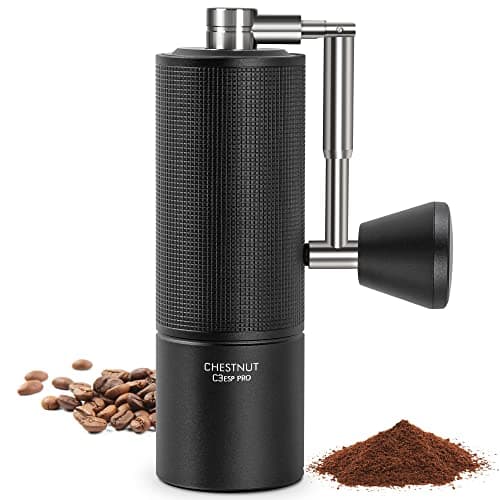 | One or two cups a day, by hand | Best on a budget | |
| 3 | 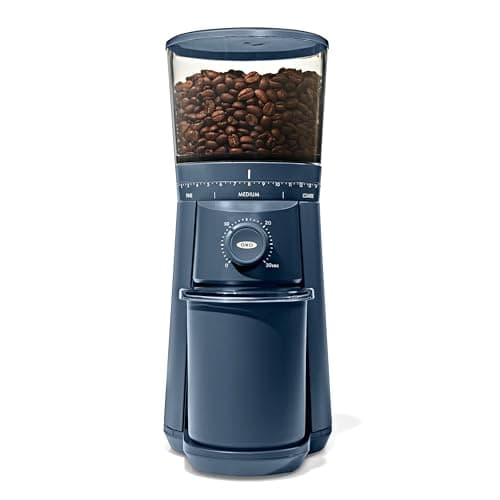 | A cheaper electric with a timer | Best electric under the Encore | |
| 4 | 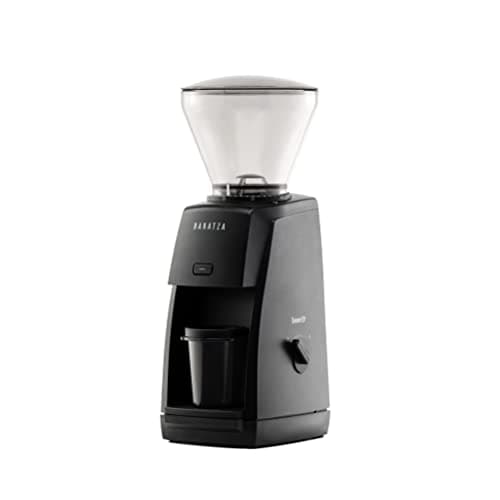 | A first grinder that survives buying an espresso machine | If espresso is coming | |
| 5 | 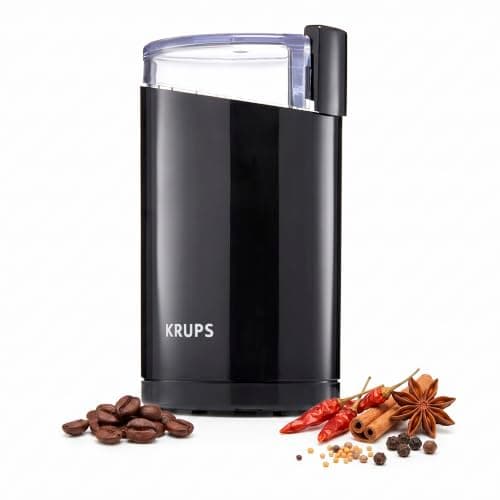 | Spices, not coffee | Skip this |
1. Top pick
Baratza Encore
Entry tier · The standard entry burr grinder for filter brewing.
40 stepped settings across 250-1200 microns, and parts sold for years.
The Encore is the default first grinder for a reason: 40 mm conical burrs made in Europe, 40 stepped settings, and a published range of 250 to 1200 microns that covers French press, drip and pour-over.
Its burrs turn at roughly 450 to 550 rpm. Slow burrs mean less heat and less static, which for a beginner means grounds that land in the basket instead of across the counter.
Baratza sells parts individually and publishes repair guides. A first grinder that can be repaired is a grinder you stop thinking about.
There is no timer and no scale, so weighing beans is part of the routine - which is the habit worth building anyway.
It cannot grind espresso, it is loud, and the body is plastic. None of those affect the cup, and the first is the one to check against your plans.
Specification
- Burrs
- 40 mm conical, made in Europe
- Settings
- 40 stepped
- Grind range
- 250-1200 microns
- Burr speed
- Roughly 450-550 rpm to limit heat and static
What it does well
- The reference answer for pour-over, drip and French press
- Fully serviceable, with parts sold individually for years
- Low burr speed keeps static and heat down
Where it gives ground
- Bottom of its range is too coarse for espresso - that is the ESP model job
- Stepped settings only
- Plastic body and a loud motor
Skip it if
Skip it if an espresso machine is in the plan - buy the ESP model instead and keep one grinder.
2. Best on a budget
Timemore Chestnut C3
Manual tier · The budget hand grinder that made stainless conical burrs cheap.
38 mm stainless burrs and metal internals for less than most electric grinders.
The C3's 38 mm S2C stainless burrs at 55 to 58 HRC across roughly 36 settings put real grinding hardware below the price of the cheapest decent electric grinder.
Its aluminum body, double-bearing axis and absence of plastic internals are why the burrs stay aligned - which is precisely what fails first in cheap electric grinders.
Grinding a 17 g dose by hand takes under a minute. For a single pour-over or AeroPress that is a fair trade for the money saved.
Capacity is 25 g, which is one dose. That is a limit, and for a beginner brewing one cup it is also the natural workflow.
Espresso is marginal here, and hand grinding is a preference - if someone else in the house makes the coffee, buy a plug instead.
Specification
- Burrs
- 38 mm S2C stainless conical, 55-58 HRC
- Settings
- Roughly 36, about 0.0233 mm per click
- Capacity
- 25 g
- Weight
- About 530 g
- Build
- Aluminum body, double-bearing axis, no plastic internals
What it does well
- Filter-grade grind quality at a genuinely low price
- Metal internals and double bearings, not a toy
- Small and light enough to travel with
Where it gives ground
- 38 mm burrs make an espresso dose slow work
- Espresso resolution is marginal
- 25 g capacity limits you to one brew at a time
Skip it if
Skip it if you brew a full carafe. Grinding 60 g by hand every morning gets old fast.
3. Best electric under the Encore
OXO Brew Conical Burr Grinder
Entry tier · A 40 mm conical burr grinder with a timer and a UV-blocking hopper.
40 mm burrs, 15 settings plus 29 micro-adjustments, and a UV-blocking hopper.
The OXO puts real 40 mm stainless conical burrs at a price where blade grinders still dominate the shelf.
Its 15 main settings hide 29 micro-adjustments, which gives far finer control than the headline number suggests.
A one-touch timer remembers your last setting, so the morning routine is a single button - genuinely useful when you are still learning.
The hopper holds up to 12 oz and blocks UV, which is a thoughtful detail at this price: light degrades coffee.
Espresso is at the edge of its range rather than inside it, timed dosing drifts as beans age, and static makes grounds cling to the bin.
Specification
- Burrs
- 40 mm stainless steel conical
- Settings
- 15 main settings plus 29 micro-adjustments
- Hopper
- Up to 12 oz, UV-blocking
- Dosing
- One-touch timer, remembers the last setting
What it does well
- Real 40 mm burrs at a price where blade grinders still dominate
- The micro-adjustments give far finer control than 15 settings suggests
- UV-blocking hopper is a genuinely thoughtful detail at this price
Where it gives ground
- Espresso is at the very edge of its range rather than inside it
- Timed dosing drifts as beans age
- Static means grounds cling to the bin
Skip it if
Skip it if you want a documented repair path. Baratza's parts catalog is the Encore's advantage.
4. If espresso is coming
Baratza Encore ESP
Entry tier · The Encore re-geared for espresso: the same 40 mm burrs on a dual-resolution collar.
The Encore re-geared: 20 microns per click across the espresso half.
The ESP puts 40 mm M2 steel Etzinger burrs on a dual-resolution collar: about 20 microns per click for espresso across steps 1 to 20, about 90 for filter across 21 to 40.
Twenty microns per click is what makes dialing a shot possible rather than a guessing game - the standard Encore cannot do it at any setting.
Its burr housing was redesigned to come apart easily and shims are included, which makes cleaning and range-shifting a beginner-friendly job.
Same repair path as the rest of the Baratza range: parts sold individually, guides published.
Its filter half is coarser per click than the standard Encore's even steps, so a filter-only household pays for range it will not use.
Specification
- Burrs
- 40 mm M2 steel conical (Etzinger)
- Settings
- 40 stepped, dual resolution
- Espresso range
- Steps 1-20, 20 microns per click
- Filter range
- Steps 21-40, 90 microns per click
- Burr speed
- 550 rpm
What it does well
- 20 microns per click in the espresso range is real dialing resolution
- Redesigned burr housing makes cleaning and shimming easy
- Shims included in the box
Where it gives ground
- Still a stepped grinder - you cannot land between clicks
- Retention is normal-for-the-class, not low
- Same plastic body and noise as the Encore
Skip it if
Skip it if you are certain espresso will never happen - the standard Encore is better spaced for filter.
5. Skip this
KRUPS F203 Blade Grinder
Budget tier · A 200 W blade grinder that chops rather than grinds - fine for spices, poor for coffee.
A blade grinder has no settings and cannot produce an even grind.
A blade grinder chops for as long as you hold the button. There is no grind setting, so particle size depends on your patience rather than on a mechanism.
What comes out is dust and boulders together. The dust over-extracts into bitterness while the boulders barely extract at all - in the same cup, at the same time.
This is the single most common first-grinder mistake, and it is the reason people conclude that home coffee cannot taste good.
It is genuinely useful for spices, nuts and seeds, and it costs very little. Those are real virtues for a different job.
A hand grinder at a fraction of an electric burr grinder's price beats any blade grinder made - see burr grinder vs blade grinder.
Specification
- Type
- Blade, not burr
- Power
- 200 W
- Capacity
- 3 oz
- Blades
- Stainless steel
- Safety
- Lid-activated switch
What it does well
- Fast and inexpensive
- Handles spices, nuts and seeds as well as coffee
- Compact and simple to clean
Where it gives ground
- Chops beans into a mix of dust and chunks rather than an even grind
- No grind setting - particle size depends on how long you hold the button
- The dust it makes passes straight through a French press screen
Skip it if
Skip it for coffee entirely. Keep it for spices if it is already in the cupboard.
How the four compare
Scroll the table sideways to see every column.
How to use a new grinder well
Start in the middle of the range and move one click at a time. A first grinder's settings mean nothing on paper; they mean something once you have brewed the same coffee twice at adjacent numbers.
Grind immediately before brewing. Ground coffee stales within days because grinding multiplies the exposed surface area, which is the entire reason you bought a grinder.
Weigh the beans, not the grounds. Weighing before grinding means the whole dose goes into the brew and nothing is left guessing in the chamber.
Clean it occasionally. Coffee oils build on burrs and in the chute, and a grinder that has never been brushed out tastes stale no matter how fresh the beans are.
When to upgrade - and when not to
Upgrade when the grinder stops you doing something: it cannot reach espresso, it cannot grind a carafe quickly enough, or the setting you want sits between two clicks. Those are real limits.
Do not upgrade because a brew tasted bad once. Grind is one of four variables - dose, water temperature, time and grind - and the other three are free to change. Working through them in order is how you learn what your grinder is actually doing - see the grind size chart.
Spend here before the brewer
A good grinder improves every brewer you own. A good brewer does nothing for a bad grind - an uneven grind extracts unevenly no matter how carefully the water arrives.
If a fixed budget has to cover both, give the grinder the larger half and buy a simpler brewer. That order is the single most useful piece of advice on this page - see how to choose a coffee grinder.