The short answer
Buy the DF54 if you pull one or two shots a day, weigh your dose anyway, and want flat burrs and near-zero retention in the smallest package that offers both. The published specification is genuinely strong for the money: 54 mm custom stainless flat burrs, stepless adjustment, a plasma ionizer in the exit chute for static, an anti-popcorn disc, and a true-zero retention claim the maker explicitly makes without a bellows. Two things to know before you buy, and the listing answers neither. It is sold under several different storefront names, so confirm which seller and which hardware revision you are actually getting. And the adjustment is stepless with no reference marks, so your setting lives in a note rather than on a dial. If you want numbered steps instead, buy the Baratza Encore ESP; if you want the bigger burrs, buy the DF64 Gen 2.
Who actually makes the DF54
This is the single most-asked question about this grinder and the hardest one to answer honestly, so it goes first rather than in a footnote.
The DF54 is sold under a number of different storefront names. The Amazon listing we link carries the brand field "DF64Coffee" and the model "DF54". Elsewhere the same model designation appears under other sellers' names, and shoppers routinely search for it attached to several of them at once - which is why "who makes the DF54", "what brand is the DF54" and "where is the DF54 made" are all common searches with no settled answer in the results.
What we are not going to do is tell you that every DF54 on sale is identical hardware from one factory with different badges on it. That is the common assumption and we cannot verify it from anything published. What we can say is narrower and more useful: the specification quoted on this page is the one published on the listing linked here, and if you buy a DF54 from a different seller you should check the burr material, the version and the included accessories against it rather than assuming they carry over.
Quick picks
The answer first. Tap any row to jump to the full reasoning for that pick.
Prices shown are checked daily against the retailer, as of November 13, 2026. We never write a price into the text of a page.
| # | Product | Best for | Award | Price |
|---|---|---|---|---|
| 1 | 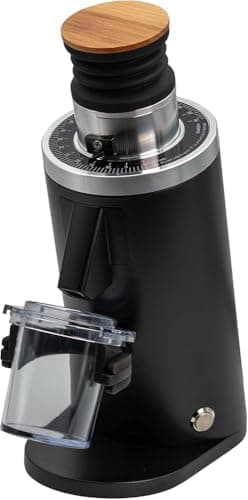 | One or two espresso shots a day, weighed in, on a counter with no room to spare | The grinder reviewed | |
| 2 | 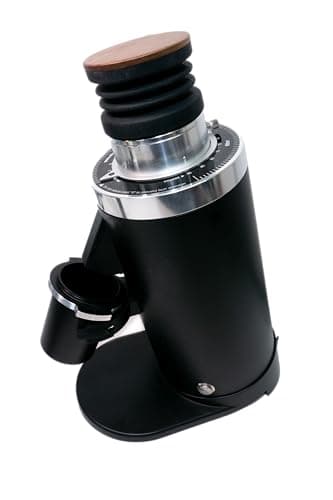 | Light roasts, a serious espresso setup, and counter space to give it | Buy this instead for bigger burrs | |
| 3 | 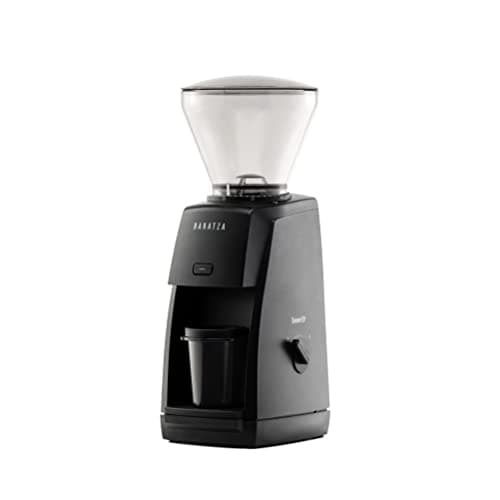 | Someone who wants espresso resolution without keeping a grind diary | Buy this instead if stepless sounds like a chore |
1. The grinder reviewed
DF54
Upper-mid tier · A single-dose grinder with 54 mm flat burrs and stepless adjustment.
Flat burrs, stepless adjustment and near-zero retention, in the smallest package that offers all three.
The DF54 exists because of one trade: it takes the single-dose flat-burr format that used to start around the price of a decent espresso machine and shrinks the burrs from 64 mm to 54 mm. Almost everything else about the format survives the cut.
The burrs are the headline. The maker describes them as custom-made stainless steel 54 mm flats, and flat burrs are the geometry espresso grinders are benchmarked on - they tend toward a narrower particle distribution than conicals at espresso settings, which is what makes a shot easier to dial and repeat. Conical versus flat burrs covers why that difference shows up in the cup.
Two features on the listing are aimed squarely at the problems single-dose grinders are known for. The exit chute carries a plasma ionizer, which neutralizes the static charge that otherwise sprays grounds across the counter, and an integrated anti-popcorn disc holds the beans down so they feed into the burrs instead of bouncing on top of them - the maker's stated reason is faster grinding, and the side effect is a more even feed.
Retention is the claim worth reading carefully, because the maker goes further than most: it states true zero retention, achieving almost zero retention *even without a bellows*. That qualifier matters. Most single-dose grinders quote low retention on the assumption you will puff a bellows after every dose; this one claims the number without that step.
It is a 25 g single-dose hopper, 150 W at 1400 rpm, 12 inches tall, 4.48 inches wide and about 10 pounds, and a 58 mm transparent dosing cup is in the box rather than sold separately. For a flat-burr grinder, that footprint is genuinely small.
Specification
- Burrs
- 54 mm flat
- Adjustment
- Stepless
- Retention
- Under 0.1 g
- Motor
- 150 W, 1400 rpm
- Hopper
- 25 g single-dose
- Anti-static
- Ionizer in the exit chute
What it does well
- Flat burrs and stepless adjustment at a price that used to buy neither
- Near-zero retention means the dose you weigh is the dose you get
- Small footprint for a flat-burr grinder
Where it gives ground
- Stepless with no reference marks is fiddly until you make your own
- Single-dose only - no hopper workflow for a busy household
- Bellows and a dosing cup are part of the routine, not optional extras
Skip it if
Skip it if more than two people make coffee at different times - this is a weigh-in, single-dose workflow with no hopper to fall back on. Skip it too if you want numbered detents; the adjustment is stepless with no reference marks.
2. Buy this instead for bigger burrs
DF64 Gen 2
Upper-mid tier · The 64 mm flat-burr single-dose grinder that made the format mainstream at home.
The same format on 64 mm flats - the size the espresso world actually benchmarks against.
The DF64 Gen 2 is the grinder the DF54 was shrunk from, and the honest summary of the difference is 10 mm of burr.
That sounds small and is not. A larger flat burr set does the same work across more cutting surface, which generally means fewer passes per particle and a tighter distribution - the effect shows up most on light roasts, which are harder and less forgiving, and least on dark roasts where almost any decent grinder copes.
It publishes a stronger motor at 250 W and the same 1400 rpm, a 50 g hopper rather than 25 g, and the same under-0.1 g retention and chute ionizer. The burrs are swappable, which means the grinder can be re-tuned with an aftermarket set rather than replaced - that upgrade path does not really exist at 54 mm.
The costs are physical and financial. It is 30 cm tall and 6.8 kg against the DF54's roughly 10 pounds, and it carries a clear premium - check the buttons on this page for what that gap is today.
If you are weighing the two directly rather than reading about one of them, DF64 Gen 2 vs DF54 is the page that does that comparison properly, and the full DF64 Gen 2 review goes deeper on the larger machine.
Specification
- Burrs
- 64 mm flat stainless; aftermarket sets available
- Adjustment
- Stepless
- Retention
- Under 0.1 g
- Motor
- 250 W, 1400 rpm at 110/120 V
- Hopper
- 50 g
- Size
- 13 cm W x 22.5 cm D x 30 cm H, 6.8 kg
What it does well
- 64 mm flats are the burr size the espresso world benchmarks against
- Burrs are swappable, so the grinder can be re-tuned rather than replaced
- Ionizer probes in the chute keep static manageable
Where it gives ground
- Heavy and tall for a home counter
- Stepless adjustment with no detents demands note-keeping
- Version numbering across sellers is genuinely confusing
Skip it if
Skip it if your counter is tight or you mostly drink medium and dark roasts. The extra burr diameter earns its money on light roasts and on volume, and buys less than people expect otherwise.
3. Buy this instead if stepless sounds like a chore
Baratza Encore ESP
Entry tier · The Encore re-geared for espresso: the same 40 mm burrs on a dual-resolution collar.
40 numbered steps with the first 20 reserved for espresso - a setting you can write down and return to.
The single biggest practical complaint about the DF54 is not its burrs, it is its adjustment, and this is the grinder that solves that problem a different way.
Baratza's Encore ESP uses a dual-range stepped system: micro-steps from #1 to #20 for espresso and macro-steps from #21 to #40 for filter. Every setting has a number. You write down 12, you come back to 12, and the shot is where you left it - which on a stepless grinder takes a mark of your own making and a note.
Its burrs are 40 mm hardened steel conicals rather than flats, which is a real difference rather than a lesser version of the same thing: conicals tend toward a wider particle distribution and a rounder, heavier cup, flats toward clarity and separation. Neither is better in the abstract.
The burr mount is quick-release, so the burrs come out for cleaning without dismantling the machine - worth more on an espresso grinder than on a filter one, because an espresso grinder gets opened more often.
It is also a hopper grinder rather than a single-dose one, so it holds beans between sessions. That suits a household and works against anyone who switches between small bags of single origin, since coffee sits in the path between doses.
Specification
- Burrs
- 40 mm M2 steel conical (Etzinger)
- Settings
- 40 stepped, dual resolution
- Espresso range
- Steps 1-20, 20 microns per click
- Filter range
- Steps 21-40, 90 microns per click
- Burr speed
- 550 rpm
What it does well
- 20 microns per click in the espresso range is real dialing resolution
- Redesigned burr housing makes cleaning and shimming easy
- Shims included in the box
Where it gives ground
- Still a stepped grinder - you cannot land between clicks
- Retention is normal-for-the-class, not low
- Same plastic body and noise as the Encore
Skip it if
Skip it if you want flat burrs specifically, or if you switch coffees constantly - a hopper holds the last bean and the first dose of a new bag is partly the old one. The full Encore ESP review has the detail.
The specification, and what each line actually buys you
Scroll the table sideways to see every column.
Stepless adjustment is the thing people underestimate
Stepless means the burrs move continuously rather than clicking through numbered positions. The advantage is real and it is the reason serious espresso grinders work this way: you can land exactly on a setting instead of jumping past it, which matters enormously when the difference between a 26-second shot and a 34-second one is a fraction of a turn.
The cost is that there is nothing to write down. On a stepped grinder you note "12" and return to it. On this one the setting exists only as a physical position, and if you move it to grind for a French press you have to find espresso again by feel. Owners solve this the same way every time - a paper or tape scale stuck to the collar, with their own marks on it - and a dial indicator is a popular aftermarket addition for exactly this reason.
Decide which of those two you are before you buy. If you pull the same shot from the same bag every morning, stepless costs you almost nothing. If you switch between espresso and pour-over on the same grinder, a stepped machine will annoy you considerably less.
Static, retention and the anti-popcorn disc
Three of the listing's five bullets address problems specific to single-dose grinding, which tells you what this format's real complaints are.
- Static is what makes coffee cling to the chute and leap off the counter. The maker's answer is a plasma generator in the exit chute that neutralizes the charge. Grinding very dry beans or very light roasts is where static is worst, so this is not a cosmetic feature.
- Retention is coffee left inside the grinder after a dose, which means the dose you weighed is not the dose you brewed - and the leftovers go stale and join tomorrow's shot. The maker states true zero retention and specifically that it holds even without a bellows, which is a stronger claim than the category norm.
- Popcorning is beans bouncing on top of the burrs instead of feeding in, which is a single-dose problem because there is no weight of beans above them pressing down. An integrated disc holds them in place; the maker cites faster grinding, and the more even feed is the benefit that reaches the cup.
Retention is also why single-dose grinders suit people who buy small bags and switch often: with nothing held in the path, the first dose from a new bag is that bag rather than a blend with the last one. Single-dose versus hopper grinders sets out that trade in full.
Who this grinder is for
- You pull one or two shots a day and weigh the dose. The 25 g single-dose hopper is a feature rather than a limit, and the retention claim is doing real work for you.
- Your counter is small. At 4.48 inches wide this is one of the narrowest flat-burr grinders available; most of the alternatives are considerably bulkier.
- You buy small bags of single origin. Near-zero retention means you taste the bag you just opened.
- You want flats without the flat-burr price. This is the whole argument for the machine - 54 mm of flat burr for meaningfully less than a 64 mm grinder.
Who should buy something else
- A household where several people make coffee. Weigh-in single dosing is a solo or two-person routine; a hopper grinder is less friction for everyone else.
- Anyone who wants a setting they can write down. Stepless adjustment with no marks is a note-keeping exercise. The Baratza Encore ESP gives you numbers.
- Light-roast espresso specialists. This is the clearest case for spending up to 64 mm burrs, where the extra cutting surface earns its money.
- Anyone who will not establish what they are buying. Given how many names this grinder is sold under and how often version numbers come up, a buyer who will not check the seller and the revision should pick a grinder from a brand with one listing and one spec sheet.