The short answer
Start at 1:16 by weight for filter coffee - 20 g of coffee to 320 g of water - and 1:2 for espresso, 18 g in for 36 g out. Then adjust to taste, and adjust the grind rather than the ratio once you have settled one. The widely repeated claim that 1:16 is the Specialty Coffee Association's published golden ratio is not verifiable: the SCA's home-brewer standard SCA-310 sits behind member login and its public pages state no ratio. 1:16 is a good starting point on its own merits, not an authority's figure.
The chart
Scroll the table sideways to see every column.
What Hario actually publishes for the V60
This is worth setting out properly, because the V60 is the brewer most ratio charts quote a Hario figure for. Hario's own V60 page does not give grams. It gives multiples of the coffee weight:
- Bloom with twice as much hot water as the amount of coffee.
- Then divide the pouring of hot water into 3 parts, each one 4 times the amount of ground coffee.
- Brewing time within 3 minutes, regardless of the number of cups.
Add those up and the arithmetic gives a total of 14 times the coffee weight: 2 for the bloom plus three pours of 4. So Hario's published recipe works out at 1:14 - for 20 g of coffee, 40 g to bloom and three pours of 80 g, 280 g in total.
That figure is our arithmetic from Hario's multiples, not a number Hario prints. It is also tighter than the 1:15 to 1:17 most people brew a V60 at, which is a real and useful disagreement rather than a rounding error: 1:14 is a stronger cup.
What the AeroPress publishes, and why it has no ratio
AeroPress is the one maker on this page that publishes doses properly, in both grams and scoops - for example "1 heaping Scoop or 16-18 grams" of medium ground coffee, or "32-36 grams or 2 heaping Scoops" for a stronger method, and 12-14 g for the Go.
What it does not publish is a water weight. Water is specified by the numbered lines on the chamber - "pour water up to the 4", "up to #8", "up to #3" - so the recipe is a dose plus a fill line, not a ratio. You can weigh the water yourself to convert it, but the ratio is not the maker's number.
Why this page will not cite an SCA golden ratio
Nearly every ratio chart online attributes 1:16, or a figure near it, to the Specialty Coffee Association's "golden ratio" or "golden cup standard". We went looking for the citation and could not find one that is publicly readable.
The SCA's standards index lists its home-brewer document as SCA-310 Home Coffee Brewers: Specifications and Test Methods, and states that it is available exclusively to SCA members behind a login. The public certified-home-brewer page states no ratio and no brew temperature. So the number may well be in the standard - we simply cannot read it, and neither can almost anyone repeating it.
This matters beyond pedantry. A ratio presented as an authority's standard discourages you from changing it, and the single most useful thing you can do with a starting ratio is move it until the coffee tastes right to you. 1:16 is a good place to begin because it works, not because a body certified it.
Quick picks
The answer first. Tap any row to jump to the full reasoning for that pick.
Prices shown are checked daily against the retailer, as of October 17, 2026. We never write a price into the text of a page.
| # | Product | Best for | Award | Price |
|---|---|---|---|---|
| 1 | 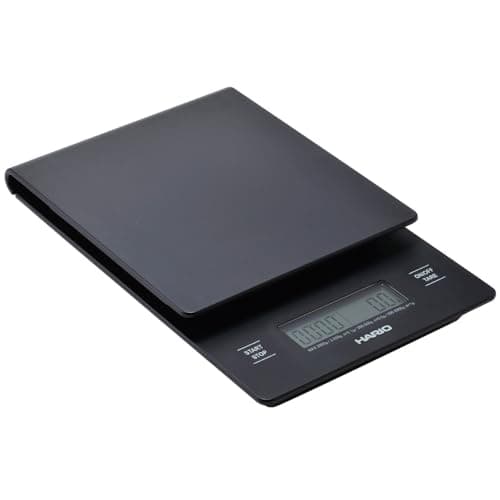 | Anyone currently measuring coffee with a spoon | Cheapest way to brew by ratio | |
| 2 | 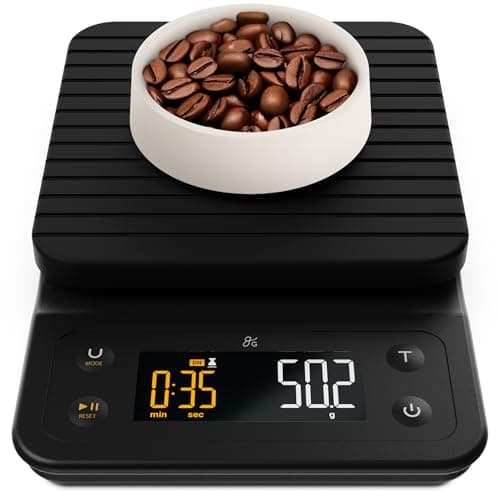 | Brewing by ratio without babying the scale | Best for a wet counter | |
| 3 | 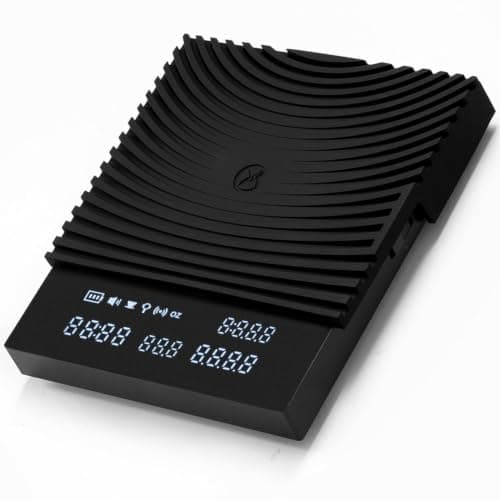 | Pour-over brewers working on consistency of pour, not just dose | If you want the scale to show flow rate |
1. Cheapest way to brew by ratio
Hario V60 Drip Scale
Budget tier · A basic brewing scale with an integrated count-up timer.
0.1 g resolution from 2 to 200 g and a count-up timer - the two things a ratio needs.
A ratio is two weights. Without a scale you have neither, and every number on this page is unusable - which is why a cheap scale changes more about a brew than most gear costing ten times as much.
This one gives 0.1 g resolution between 2 and 200 g, which covers any dose of coffee, with a 2000 g capacity so a full server sits on it. The count-up timer runs to 99:59.
The platform is 120 by 190 mm - long and narrow, which is the right shape for a dripper on a carafe rather than a square kitchen scale the brewer overhangs.
It powers off after five minutes, which is the difference between batteries lasting a year and lasting a month.
It is not water resistant, and it spends its life under a pouring kettle. That is the honest risk at this price. It is also slower to respond than premium scales and has no flow-rate display.
Specification
- Capacity
- 2000 g
- Resolution
- 0.1 g between 2 and 200 g
- Timer
- Count-up to 99:59
- Size
- W120 x D190 x H29 mm
- Water resistance
- None
What it does well
- Does the two things a brew scale must do, for very little money
- Long, narrow platform suits a dripper and server
- Auto power-off after five minutes
Where it gives ground
- Not water resistant, and it sits under a pouring kettle
- Slower response than the premium scales
- No flow-rate display
Skip it if
Skip it if you are weighing espresso shots on a drip tray - the lack of water resistance and the slow response both matter there. See best coffee scales for espresso.
2. Best for a wet counter
Greater Goods Coffee Scale with Timer
Budget tier · A 0.1 g coffee scale with a timer, physical buttons and a protective silicone cover.
0.1 g with physical buttons and a dishwasher-safe silicone cover over the platform.
The practical failure of brew scales is water, and this is the one built for that. A heat-resistant, dishwasher-safe silicone cover sits over the platform, so a spill or a hot kettle base is a wipe rather than a dead scale.
Its buttons are physical rather than capacitive touch, which matters more than it sounds: touch panels misread wet fingers, and brewing coffee involves wet fingers.
Resolution is 0.1 g with a 0.3 g minimum and a 3000 g capacity, and the timer counts both up and down. Six units are supported if you follow recipes written in ounces.
Greater Goods puts a five-year warranty on it, which is unusual at this price and the best evidence available that it is not built to fail.
Auto-off after two minutes idle is short - it will switch off mid-brew if you pause. And it has no ratio or flow-rate display, which the pricier scales do.
Specification
- Capacity
- 3000 g
- Resolution
- 0.1 g; minimum 0.3 g
- Timer
- Count-up and count-down
- Units
- 6
- Cover
- Heat-resistant, dishwasher-safe silicone
- Auto-off
- After 2 minutes idle
- Warranty
- 5 years
What it does well
- Physical buttons work reliably with wet fingers
- The silicone cover protects the platform from spills and hot kettles
- A 5-year warranty is unusual at this price
Where it gives ground
- No ratio or flow-rate display, which the Maestri House S3 has
- Built for general kitchen use as much as coffee
- Larger than a dedicated espresso scale
Skip it if
Skip it if you want the scale to do the ratio arithmetic for you. This weighs and times; it does not calculate - see best coffee scales.
3. If you want the scale to show flow rate
Timemore Black Mirror Basic Plus
Mid tier · A rechargeable coffee scale with auto-timing and a flow-rate readout.
Automatic timing and a flow-rate readout, USB-C rechargeable.
Once your ratio is fixed, the next variable is how fast you pour, and this is the cheapest scale that shows it. A flow-rate readout turns an invisible technique into a number you can repeat.
It starts timing automatically when the first water hits, so you are not reaching for a button with a kettle in one hand.
Resolution is 0.1 g with a 0.5 g minimum detectable weight and 2000 g capacity. It is 152 by 130 by 26 mm at about 380 g, which fits a drip tray and still takes a dripper.
It charges over USB-C on a 1600 mAh battery rated up to ten hours, so there is no drawer of coin cells.
It is not waterproof, its response is quick but not espresso-instant, and the mirrored top shows every fingerprint.
Specification
- Capacity
- 2000 g
- Resolution
- 0.1 g; minimum detectable 0.5 g
- Timer
- Automatic timing
- Battery
- 1600 mAh, up to 10 hours, USB-C
- Size
- 152 x 130 x 26 mm, about 380 g
What it does well
- Auto-timing and flow rate at a fraction of an Acaia
- USB-C rechargeable rather than a drawer full of coin cells
- Small enough for a drip tray, big enough for a dripper
Where it gives ground
- Not waterproof
- Response is quick but not espresso-instant
- The mirrored top shows every fingerprint
Skip it if
Skip it if you only brew French press or drip. Flow rate is meaningless in an immersion brew and automatic on a machine.
How to adjust, in the right order
Step 1
Fix the ratio first
Pick one - 1:16 for filter, 1:2 for espresso - and brew it twice without changing anything else. You cannot judge a variable you are still moving.
Step 2
Judge strength, not taste, from the ratio
Too weak and watery across the whole cup means more coffee or less water. Ratio controls how strong the drink is, and little else.
Step 3
Then adjust grind for the fault
Bitter, harsh and drying means over-extraction - grind coarser. Sour, thin and salty means under-extraction - grind finer. These are grind problems, not ratio problems, and changing the ratio to fix them hides the cause.
Step 4
Change one thing at a time
Moving grind and ratio together means a cup that is different for reasons you cannot separate. Settle the grind, then revisit the ratio once if you want it stronger or weaker.
Espresso is a ratio too
Espresso is measured as dose in to liquid out, which is why it needs a scale as much as filter brewing does. A standard starting point is 1:2 - an 18 g dose producing 36 g in the cup, typically in 25 to 30 seconds.
A ristretto is the same dose stopped at roughly 1:1, and a lungo is the same dose run out to 1:3 or 1:4. Those are ratio decisions rather than different coffees, which is the useful thing to understand about the menu - see espresso vs ristretto and espresso vs lungo.
Note what machine makers publish and what they do not: a basket dose, such as 18 g or 22 g, is a specification. The output weight is yours to choose, and no machine publishes it - see how to dial in espresso.