The short answer
Buy a pitcher sized to the drink you are making - around 12 oz for a single drink, around 20 oz for two. The wrong size is the most common reason home milk texturing fails, because the steam tip cannot reach the right depth. After size, the spout shape decides whether you can pour a pattern.
Why size decides whether texturing works
Texturing milk is a sequence of two tip positions. First the steam tip sits just below the surface, so steam draws air into the milk - this is stretching. Then the tip submerges further so the milk spins in the pitcher, breaking the large bubbles down into microfoam - this is rolling.
Both positions are defined relative to the surface of the milk and the shape of the pitcher. If there is too little milk for the pitcher, the tip cannot submerge deep enough to roll without hitting the bottom. If there is too much, it cannot get near enough to the surface to stretch cleanly.
That is why a pitcher matched to the drink is not a refinement. It is the condition under which the technique works at all.
Quick picks
The answer first. Tap any row to jump to the full reasoning for that pick.
Prices shown are checked daily against the retailer, as of October 23, 2026. We never write a price into the text of a page.
| # | Product | Best for | Award | Price |
|---|---|---|---|---|
| 1 | 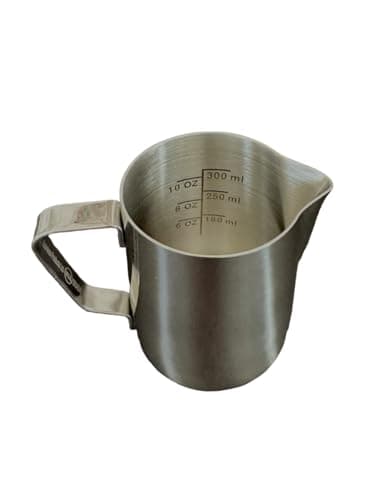 | One cappuccino, macchiato or small latte | Top pick for single drinks | |
| 2 | 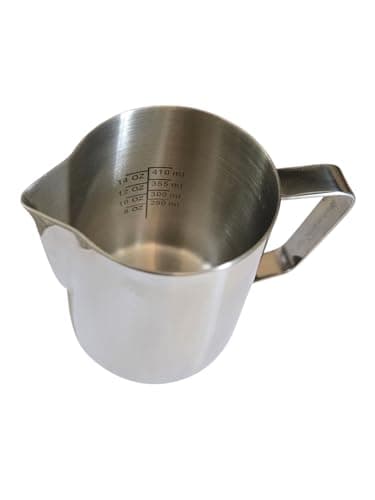 | Two drinks at a time, or one large latte | Best for two drinks | |
| 3 | 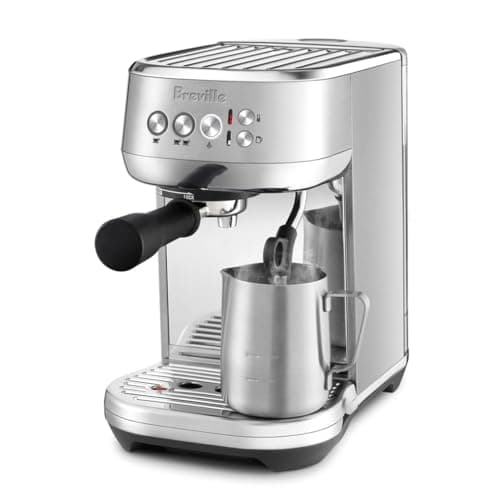 | Buyers who have not chosen a machine yet | The machine that comes with one | |
| 4 | 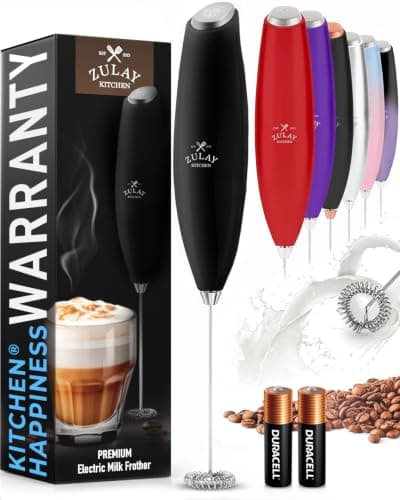 | Households with no espresso machine | Skip this if you have a steam wand |
1. Top pick for single drinks
Rattleware 12 oz Latte Art Pitcher
Entry tier · A 12 oz stainless steaming pitcher with a tapered spout, sized for single drinks.
The size almost everyone should own first, and almost nobody buys.
The 12 oz Rattleware is stainless with a tapered, drip-resistant spout, sized for a macchiato, cappuccino or small latte.
Twelve ounces is the size that suits most home espresso, and it is consistently the one people do not buy - the instinct is to get the larger pitcher to have the option. That instinct produces bad milk.
Texturing works by holding the steam tip just below the surface to draw air in, then submerging it to roll the milk. Both positions depend on the depth of milk in the pitcher. Put 5 oz of milk in a 20 oz pitcher and the tip cannot reach either position properly.
The tapered spout is what makes a controlled pour possible - it narrows the stream so you can place it rather than dump it.
Specification
- Capacity
- 12 oz
- Material
- Stainless steel
- Spout
- Tapered, drip-resistant
- Suits
- Macchiato, cappuccino, small latte
What it does well
- Correct size for a single drink, which matters more than people expect
- Tapered spout is what makes a controlled pour possible
- Commercial-grade construction at a domestic price
Where it gives ground
- Too small for two drinks at once
- No etched graduations at this size
- Stainless conducts heat, so it gets hot in the hand
Skip it if
Skip it if you regularly make two drinks at once. It genuinely will not hold enough.
2. Best for two drinks
Rattleware 20 oz Latte Art Pitcher
Entry tier · A 20 oz stainless steaming pitcher with etched graduations and a tapered spout.
Etched graduations and a properly engineered spout, for a household making more than one.
The 20 oz is the second pitcher to own, not the first. It is stainless with etched graduations and a tapered spout engineered for pouring microfoam.
The etched graduations are the practical advantage: you can measure milk in the pitcher rather than in a separate jug, which removes a step and a guess.
Twenty ounces suits two drinks, or a single large latte. Attempting a single small cappuccino in it means too little depth for the wand to work with.
It is heavier when full, which makes a controlled pour harder until you are used to it - one of the small reasons the 12 oz is the better first pitcher.
Specification
- Capacity
- 20 oz
- Material
- Stainless steel
- Spout
- Tapered, engineered for pouring microfoam
- Markings
- Etched graduations
- Suits
- Latte, cappuccino, flat white; two drinks at once
What it does well
- Etched graduations mean you can measure milk without a separate jug
- Big enough for two drinks, small enough for one at a push
- The tapered spout is the reason latte art is possible at all
Where it gives ground
- Too large to texture a single small drink well
- Heavier to control than a 12 oz pitcher when pouring
- Gets hot - which is how you judge temperature, but still
Skip it if
Skip it if you only ever make one drink. A 20 oz pitcher with 5 oz of milk in it is a texturing problem, not a convenience.
3. The machine that comes with one
Breville Bambino Plus
Entry tier · The Bambino with automatic milk texturing added.
Ships with a 480 ml jug, and textures into it automatically.
Worth knowing if you are buying both: the Bambino Plus includes a 16 fl oz / 480 ml stainless milk jug and textures automatically.
The espresso side is a 54 mm portafilter taking 18 g, ThermoJet heating in three seconds, a 15 bar pump delivering 9 bar at the puck, and low-pressure pre-infusion, in an 11.9 x 7.4 x 14.3 inch body.
Because texturing is automatic, the pitcher's spout matters less - you are not pouring a pattern.
If latte art is the goal, the standard Bambino with a manual wand plus a 12 oz pitcher is the better combination.
Specification
- Portafilter
- 54 mm stainless, 18 g dose
- Heating
- ThermoJet, ready in 3 seconds
- Pump
- 15 bar Italian pump, 9 bar extraction
- Milk
- Automatic texturing, 16 fl oz / 480 ml jug
- Footprint
- 11.9 x 7.4 x 14.3 in
What it does well
- Automatic milk texturing gets a usable microfoam without practice
- Same three-second heat-up as the standard Bambino
- Fits a narrow counter with a grinder beside it
Where it gives ground
- You are paying for the milk automation, not better espresso
- Still no grinder
- Auto-steam removes the control an enthusiast eventually wants
Skip it if
Skip it if you want to learn to texture. Automatic milk removes exactly the control latte art depends on.
4. Skip this if you have a steam wand
Zulay Handheld Milk Frother
Budget tier · A battery-powered handheld whisk that aerates milk in a jug or mug.
A handheld whisk cannot make microfoam, so it cannot make latte art.
The handheld frother is a reasonable product being suggested to the wrong people on pages like this one.
It runs on two AA batteries, has a stainless steel whisk in a nylon body, comes with a metal stand, and cleans by rinsing under hot water and switching it on.
It aerates milk mechanically without heating it, producing bubbly foam that sits on top of the coffee.
That is genuinely useful for someone with no espresso machine who wants a cappuccino-style drink. It is not useful to anyone with a steam wand and a pitcher, and it cannot pour a pattern.
Specification
- Power
- 2 AA batteries (included); rechargeable models also sold
- Whisk
- Stainless steel
- Body
- Nylon
- Accessories
- Metal stand included
What it does well
- The cheapest way to get foam on a coffee, by a wide margin
- Works in any vessel, including the mug you are drinking from
- Cleans by rinsing the whisk under hot water and switching it on
Where it gives ground
- Aerates but does not heat - you warm the milk separately
- Produces bubbly foam, not steam-textured microfoam
- Latte art is not possible with it
Skip it if
Skip it if you own a steam wand. A pitcher and practice will beat it comprehensively.
Matching pitcher to drink
Scroll the table sideways to see every column.
Fill to somewhere around the base of the spout as a starting point. Milk expands as it textures, and a pitcher filled to the brim will overflow the moment air goes in.
Spout shape
A tapered spout narrows the stream so you can place it precisely on the surface of the drink. A wide, shallow spout dumps milk, which breaks the crema and buries any pattern.
This is the second specification that matters, and it is the reason a purpose-made pitcher beats a jug from a kitchen shop even when both hold the same volume.
Judging temperature without a thermometer
The standard method is your hand on the side of the pitcher: when it becomes uncomfortable to hold, the milk is around the right temperature and you stop. Stainless conducts heat well, which is precisely why it is the material for this job.
Milk scalds above roughly 160 F, losing its sweetness and its texture. Stopping slightly early is always the better error.
The purchase order for milk drinks
- 1A correctly sized pitcher. Cheapest, largest effect.
- 2Practice. Free, and the largest effect of all.
- 3A machine with a bare steam wand, if yours has a Panarello sleeve. See machines for latte art.
- 4A second pitcher in the other size, once you know which drinks you actually make.