The short answer
Buy the Rancilio Silvia if you want commercial-grade parts and a repair path measured in decades, and you accept that temperature control is your job. Rancilio publishes a brass brewing group, a chrome-plated brass portafilter taking filters up to 21 g, a 0.3 liter boiler, a 2 liter tank and a 950 to 1000 W element at 120 V, in a 14 kg body - and lists temperature regulation as manual, by thermostat. There is no PID. That one omission is the whole decision: if you do not want to learn temperature surfing, buy the Silvia Pro X, which Rancilio builds as a dual boiler with a PID in each boiler, rather than buying a Silvia and bolting a controller onto it. If you mainly want the 58 mm commercial accessory standard, a Gaggia Classic Evo Pro gets you there for about half the money and publishes a 3-way solenoid valve that Rancilio's Silvia page does not mention. And whichever you buy, the grinder decides the cup: a Silvia fed by a coarse-stepped grinder is worse than a cheap machine fed by a good one.
The published specification
Taken straight from Rancilio's own page for the Silvia, with the gaps marked as gaps rather than filled in.
Scroll the table sideways to see every column.
Quick picks
The answer first. Tap any row to jump to the full reasoning for that pick.
| # | Product | Best for | Award | Price |
|---|---|---|---|---|
| 1 | 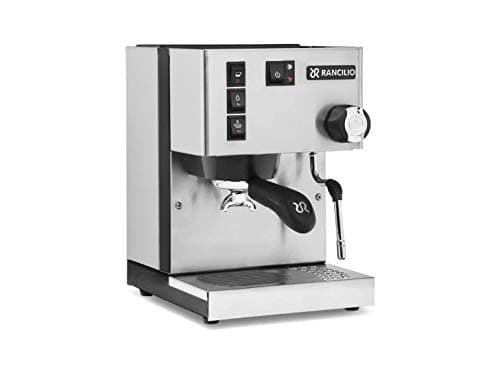 | One or two drinks at a time, from someone willing to learn a routine | The machine reviewed | |
| 2 | 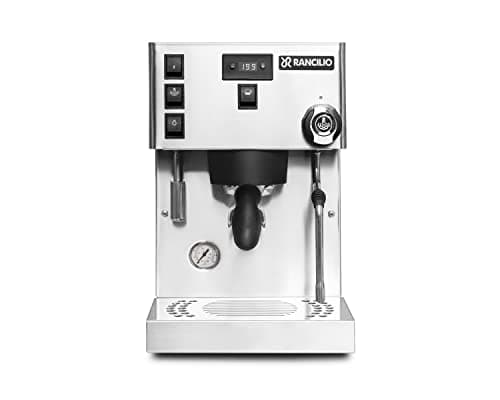 | Someone who wants Silvia build with temperature as a setting, not a skill | If the PID is the dealbreaker | |
| 3 | 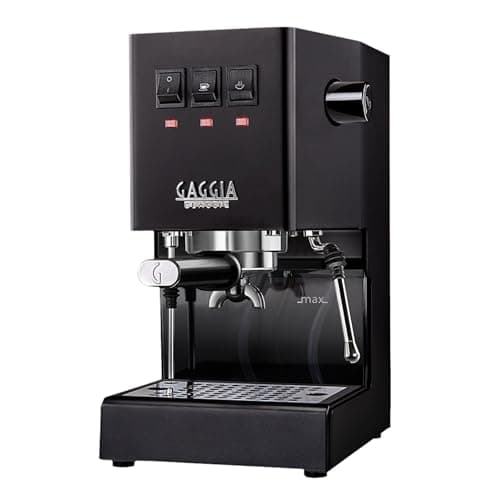 | Anyone who wants the commercial accessory path without the Silvia's money | The cheaper way onto the same standard | |
| 4 | 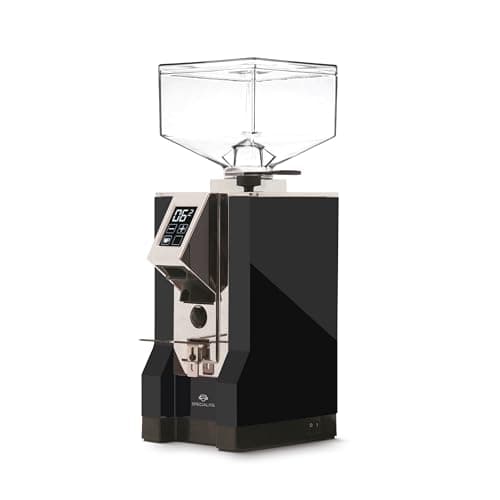 | Anyone whose Silvia budget has not yet accounted for a grinder | Buy this before you buy the machine |
1. The machine reviewed
Rancilio Silvia
Prosumer tier · A single-boiler 58 mm machine built from commercial-line parts.
Commercial-line parts and a two-decade repair path, with temperature left to you.
Rancilio publishes a brass brewing group, a chrome-plated brass portafilter that takes filters up to 21 g, baskets at 8/16 g and 14/18 g, a 0.3 liter coffee boiler, a 2 liter tank, a single vibration pump and a 950 to 1000 W element at 120 V, in a 235 by 340 by 290 mm body weighing 14 kg.
Two of those figures carry most of the machine's reputation. The brass brewing group is thermal mass: it holds heat between shots and evens out water arriving slightly too hot or too cool, which is why a Silvia produces consistent shots once it is warm. And 14 kg for a machine this size tells you most of what you need to know about how it is built.
The 0.3 liter boiler is the number people get wrong in both directions. It is small, which means it heats quickly and accumulates scale slowly - genuinely good for longevity. It also means steam capacity is finite, so it is a one-or-two-drink machine rather than a dinner-party machine.
Temperature regulation is listed as manual, by thermostat. There is no PID, and that single omission generates more owner discussion than everything else about this machine combined - see the section below.
Its honest costs: no PID means temperature surfing is part of the routine, a single boiler means waiting between brewing and steaming, and it is unforgiving of a bad grinder. It will show you every flaw in your grind, which is a feature if you have a good grinder and a problem if you do not.
Specification
- Group
- Brass brewing group, 58 mm commercial basket standard
- Portafilter
- Chrome-plated brass; takes filters up to 21 g
- Baskets
- 8/16 g and 14/18 g
- Boiler
- 0.3 L single boiler, brew and steam (Rancilio does not publish the material)
- Water tank
- 2 L
- Element
- 120 V, 950-1000 W
- Pump
- Single vibration pump
- Temperature
- Manual regulation by thermostat - no PID
- Dimensions
- 235 x 340 x 290 mm
- Weight
- 14 kg / 30.8 lb
What it does well
- A brass brewing group and chrome-plated brass portafilter hold heat like far more expensive machines
- Commercial parts and a repair path measured in decades
- Steam power well beyond its price class
Where it gives ground
- No PID; temperature surfing is part of the routine unless you add one
- Single boiler means waiting between brewing and steaming
- Unforgiving of a bad grinder - it will show you every flaw
Skip it if
Skip it if you want the machine to manage temperature for you, or if you make several milk drinks back to back.
2. If the PID is the dealbreaker
Rancilio Silvia Pro X
Prosumer tier · The Silvia rebuilt as a dual boiler with a PID on each one.
The same lineage rebuilt as a dual boiler with a PID on each one.
This is the direct answer to the most common Silvia question, and it is a different machine rather than a trim level. Rancilio publishes two boilers - separate coffee and steam - with two PID controllers, one in each.
That removes both of the standard Silvia's structural limits at once. Brew temperature becomes a number you set instead of a rhythm you learn, and the separate steam boiler means you can brew and steam simultaneously, which no single-boiler machine can do at any price.
It also adds a soft infusion function adjustable from 0 to 6 seconds, which is pre-infusion as a setting rather than a fixed behavior, plus a multi-directional stainless steam wand and the same brass brewing unit.
If you have read about temperature surfing and decided you do not want to do it, this is the machine to buy rather than a Silvia plus an aftermarket PID kit - and it is in stock through the same retailer this site links to.
It costs roughly twice the standard Silvia, which is the whole decision. Rancilio also publishes remarkably little of its specification - no boiler capacities, no wattage, no tank size, no dimensions and no weight appear on its page - and two boilers with two controllers is materially more to service than one thermostat.
Specification
- Boilers
- Two - separate coffee and steam boilers
- Temperature
- Two PID controllers, one per boiler
- Group
- Brass brewing unit
- Pre-infusion
- Soft infusion, adjustable 0 to 6 seconds
- Steam
- Multi-directional stainless steel wand
- Not published
- Rancilio's page states no boiler capacities, wattage, tank size, dimensions or weight
What it does well
- Two PIDs mean brew temperature is a number you set rather than a routine you learn
- Brews and steams at once, which the single-boiler Silvia cannot do at any price
- Soft infusion is adjustable from 0 to 6 seconds, so pre-infusion is a setting
Where it gives ground
- Costs roughly twice the standard Silvia
- Rancilio publishes very little of its specification - capacities and power are absent
- Two boilers and two controllers is materially more to service than one thermostat
Skip it if
Skip it if you drink espresso straight and one drink at a time. You would be paying double for a second boiler you will not use.
3. The cheaper way onto the same standard
Gaggia Classic Evo Pro
Mid tier · A 58 mm single-boiler machine with commercial parts and a large modification community.
Half the price, the same 58 mm basket standard, and a 3-way solenoid the Silvia does not publish.
Before buying a Silvia it is worth knowing what the obvious alternative gives you, because on two specifications it gives you more.
Gaggia publishes 1425 W total with 1375 W to a 140 ml boiler, a 2.1 L tank, a two-hole professional steam wand and - the detail that matters - a 3-way solenoid valve. Rancilio's Silvia page does not mention a solenoid at all.
A 3-way solenoid dumps line pressure after the shot, which leaves a dry puck and stops the group sitting wet under load. It is a commercial design feature and its presence is a point in the Gaggia's favor at roughly half the price.
It is also the machine with the deepest modification and spare-parts community in home espresso, which is the single best predictor of how long a machine stays usable - see espresso machines that last.
What you give up is build: a 140 ml boiler against 300 ml, and nothing in the Gaggia's published specification matches 14 kg of Rancilio. Like the Silvia it has no PID, so the temperature routine does not go away. The two compared directly.
Specification
- Portafilter
- 58 mm
- Power
- 1425 W total; 1375 W to the boiler
- Boiler
- 140 ml max capacity, 105 ml operating
- Water tank
- 2.1 L / 72 fl oz
- Steam
- Two-hole professional wand
- Valve
- 3-way solenoid
What it does well
- 58 mm from the start - every basket, tamper and portafilter fits
- The 3-way solenoid gives a dry puck, which cheap machines do not
- Serviceable and heavily documented; parts are everywhere
Where it gives ground
- No PID as shipped; brew temperature drifts with the thermostat
- Long recovery between brewing and steaming
- The modification path is a hobby, not a feature
Skip it if
Skip it if build quality and steam power are what you are buying. The Silvia is the heavier, better-made object.
4. Buy this before you buy the machine
Eureka Mignon Specialita
Upper-mid tier · An Italian 55 mm flat-burr espresso grinder with stepless micrometric adjustment.
A Silvia fed by a weak grinder makes worse espresso than a cheap machine fed by this.
This is the most useful recommendation on the page and it is not a machine. The Silvia is unforgiving by design, which means its ceiling is set entirely by what grinds for it.
The Specialita is 55 mm flat hardened steel burrs with stepless micrometric adjustment and output up to about 1.8 g per second. Stepless is the specification that matters: the distance between a sour shot and a sweet one is a fraction of a turn, and a grinder with coarse steps jumps straight over it.
On a machine with no PID and no pressure gauge, the grinder is also your only real control surface. You cannot adjust temperature as a number or watch pressure, so grind is the variable you steer the shot with.
It is genuinely quiet - the sound insulation is not marketing - and its micrometric adjustment holds its setting through a strip-down clean, which matters on a grinder you will dial in repeatedly.
It is hopper-fed by design, so single dosing it is a workaround, it has no weight-based dosing, and it costs more than half what the Silvia does. That ratio is correct and still surprises people - which Eureka Mignon to buy covers the cheaper models that share these burrs.
Specification
- Burrs
- 55 mm flat hardened steel, made in Italy
- Adjustment
- Stepless micrometric on the lower burr
- Output
- Up to 1.8 g per second
- Dosing
- Digital timed, adjustable in tenths of a second
What it does well
- Genuinely quiet - the sound insulation is not marketing
- Micrometric adjustment holds its setting through a strip-down clean
- Fast enough that an 18 g dose is a ten-second job
Where it gives ground
- Hopper-fed by design; single dosing it is a workaround
- No weight-based dosing
- Espresso-focused - the coarse end is not its strength
Skip it if
Skip it if you already own a grinder with genuine espresso adjustment. Then the grinder is not your constraint.
The PID question, which is the whole review
Rancilio lists temperature regulation as manual and brew temperature control as a thermostat. A thermostat switches the element on and off around a set point, so boiler temperature cycles up and down continuously rather than holding a line.
The practical consequence is that the temperature of your shot depends on where in that cycle you happen to pull it. Owners manage this with a routine - commonly known as temperature surfing - which means timing the shot against the heating light rather than simply pressing a button.
This is learnable and thousands of people have learned it. It is also a genuine, permanent tax on using the machine, and it is the single most common reason people either love this machine or sell it. Decide which of those you are before buying, because no accessory removes it.
The two honest ways out are both on this page: buy the Silvia Pro X, which has a PID in each of two boilers, or buy a cheaper machine and accept the same routine for less money. Fitting an aftermarket PID to a Silvia is a well-trodden third path, and it is a modification rather than a purchase - this site does not recommend buying a machine on the assumption you will rebuild it.
Why the brass group matters more than the brass reputation
The Silvia's reputation rests on brass, and it is worth being precise about which brass, because the machine's behavior follows from it.
What Rancilio publishes as brass is the brewing group and the portafilter. Both are thermal mass sitting directly in the brew path, and mass is what evens out water that arrives slightly too hot or too cool. That is the mechanism behind the consistency owners report once the machine is thoroughly warm.
It is also why warm-up matters here more than on a thermoblock machine. A 14 kg machine with a heavy brass group takes real time to reach a stable temperature, and a first shot pulled too early will taste sour no matter what the grind is doing. Locking in the empty portafilter and flushing through it is not optional on this machine - the first-run sequence is here.
Steam, and what a 0.3 liter boiler can and cannot do
The Silvia has a long-standing reputation for strong steam, and the specification supports it within a limit worth understanding.
A single boiler at 950 to 1000 W heated to steam temperature produces dry, forceful steam through a stainless wand - enough to texture milk properly rather than merely heat it. That is unusual at this price and it is a real part of what you are buying.
What 0.3 liters cannot do is sustain it. Steam capacity is a function of boiler volume, so this is a machine for one or two milk drinks in a sitting, after which it needs to recover. It also cannot brew and steam at once, because the one boiler has to change temperature between the two jobs - the layout comparison sets out what each architecture buys.
The 58 mm question, stated accurately
The Silvia is a 58 mm machine and that is a large part of why people buy it, so it is worth noting what Rancilio does and does not print.
Rancilio's specification page states the brewing group is brass and the portafilter takes filters up to 21 g, and it lists baskets at 8/16 g and 14/18 g - which are 58 mm basket designations. It does not print a group diameter anywhere, for this machine or for the Pro X.
So 58 mm here is the commercial basket standard the machine takes, universally and uncontroversially, rather than a figure quoted off a manufacturer sheet. What it buys is the deepest parts bin in espresso - baskets, bottomless portafilters, screens, gaskets and tampers from many suppliers for years. Machines with a 58 mm portafilter covers why that is a longevity feature as much as an accessory one.
Who should buy it
- You want one machine for a decade and will learn its rhythm. Commercial parts, a 14 kg body and a long repair path are exactly this.
- You drink one or two drinks at a time. The 0.3 liter boiler suits that and not a crowd.
- You already own a capable grinder. The Silvia's ceiling is set by the grind, not the machine.
- You want the 58 mm accessory ecosystem and are prepared to pay for build on top of it.
Who should not
- You want temperature as a setting. Buy the Silvia Pro X. Do not buy a Silvia planning to PID it later.
- You make several milk drinks back to back. A single 0.3 liter boiler is the wrong tool; a dual boiler is the right one.
- Your grinder is a bundled or coarse-stepped unit. Spend the difference on the grinder first and buy a cheaper machine.
- You want to be making coffee seconds after walking into the kitchen. This machine wants a real warm-up.
Verdict
The Silvia is one of the few machines at this price whose specification genuinely justifies its reputation: a brass brewing group, a brass portafilter, 14 kg of build and a parts path that outlasts most kitchens. It is also a machine that hands you one job the market has largely automated, and whether that is charm or friction is a question about you rather than about the machine.
Buy it if you want build quality and will learn the routine. Buy the Pro X if you want the build without the routine. Buy the Gaggia if what you actually wanted was the 58 mm standard. And in all three cases, put the grinder first.